Sunday, July 22, 2012

Is it only me that thinks the world is on the brink?

There are so many reasons to worry about what’s happening to our world in our time.  What has struck me recently is how ignorant of what’s going on many of my friends are.  I am alarmed that so many take Fox News to be news; Fox News itself classifies its "news" as Entertainment.  Well, most of the TV outlets have committed themselves to making "news" entertaining rather than informative.  It is not a good place to look for what’s happening to our world. Most of us who get the news on TV are being entertained but not informed.

Reason for worry about how much has changed in American society appears in our better news sources every day.  Take today’s article in the New York Times by Gretchen Morgenson about Neil Borovsky’s experience as the person who was supposed to police the TARP program.  His new book, she says, tells us how Washington seems to be working these days; well, not working.  Borovsky found little interest in exercising the responsibilities of governance, and more interest in advancing one’s career.  So many of the crucial reforms were never enacted.

Another article in today’s Times, however seeming distant from the above topic, adds to my sense of alarm.  Janine de Giovanni describes how it is possible to live in a city where war is at the doorstep while affairs inside the city are unaffected by it – that is, until something happens that radically forces upon the citizens how serious and dangerous the broader situation is.  I have seen this in many cases:  Friends in cities on the edge of war have often seemed unaware of how much danger lurks nearby, until it breaks into their social setting, often suddenly and tragically.  

It is not merely that the world is a mess that worries me.  It is that so few people around me are paying attention.  I can’t blame them because we are all busy.  We have leaders that are supposed to be doing their part while the rest of us work, doing what we are supposed to be doing.  But as we worked and slept and occasionally looked up long enough to decide who we wanted to vote for, something tragic and perhaps ineluctable has happened:  the system we thought we were living under has been co-opted by powerful forces we had little knowledge of:  powerful interests, mainly in the form of great corporations.  In fact, corporations whose true interests are global not local have intervened in the whole process of governing.  We thought we had a representative government; we elect our representatives to represent our interests in our communities, cities, states, and the federal government, right?  But another kind of element – a whole industry in fact – has intervened in the process of legislation.  It is called lobbying; representatives of the powerful and wealthy members of our society, supported by the wealth of the corporations they control, has intervened to control our government in their interest.  Our “representatives” can’t represent us because they must first pay off the big interests – usually corporate interests – who paid for the expensive process of getting elected.  

That’s why our government is unable to put into place a health system  that adequately serves all our citizens; that’s why the gun lobby can shamelessly keep this country from enacting reasonable weapons legislation (even after yet one more tragic massacre takes place in Colorado); that’s why nothing much has been done to control excess in Wall street, despite the meltdown of 2008 that continues as banks that are supposed to be too big to fail report colossal losses in “one of the greatest financial dramas of all time” (Morgenson); that’s why, in fact, Congress can scarcely pass any legislation.

What is to become of this country? And of the  world?  The most tragic events in history can be repeated in our time – only this time it will be on a global scale.  And in the mean time everyone is busy with their own local and provincial projects.  The shock will come, as it often has, in places where internecine conflict engulfs whole cities, whole societies -- and suddenly, as if without warning.

In fact, warning signs are all around us.

Thursday, July 19, 2012

A way to solve the global warming issue?

At least someone has an idea about how to solve the problem.  But is it feasible? 

What the heavens declare

One way to remind ourselves of how we fit in the larger scheme of things is to look at the scale of the universe.  
That is, into "the deep universe." 
For those of us who take the universe to be God's creation it is reason to marvel.   

Wednesday, July 18, 2012

More slander, but thanks to John McCain for challenging it

Surely we must all as Americans condemn the practice -- now becoming commonplace and even exploited in the political arena -- of slandering various individuals by means of innuendo.  
So thanks to John McCain for standing up for Homa Abaddin.
And to John Boehner. 

Tuesday, July 17, 2012

What do you say when they tell you it's hopeless?


My first draft of what I wanted to say about the quotation below was so desparing that it had to be struck out.  I will let the quotation to stand as it is, for you to draw your own moral lessons from it as you prefer.    
The statement comes from one of the world's authorities on coral reefs, Roger Bradbury, an ecologist specializing in resource management at Australian National University:   
"the global coral reef ecosystem — with its storehouse of biodiversity and fisheries supporting millions of the world’s poor — will cease to be.  Overfishing, ocean acidification and pollution are pushing coral reefs into oblivion. Each of those forces alone is fully capable of causing the global collapse of coral reefs; together, they assure it.  The scientific evidence for this is compelling and unequivocal, but there seems to be a collective reluctance to accept the logical conclusion — that there is no hope of saving the global coral reef ecosystem.
You can't say it more clearly:  The global coral reef system is dying.
What do we say to that?  And are other conditions in our environment approaching such a state?  What is there to do about such trajectories? 

More reasons to worry about the outcome of this election

Some videos worthy of our concern:


On McCain's rejection of Romney as a possible running mate:  
What did McCain find out about Romney?


Robert Reich on the risks of electing conservatives in this election:  
It certainly seems dangerous; Can it be that serious?

Thursday, July 12, 2012

The alarming scale of uncertainty in our times. Meaning what?


Rebecca Berg produced an article in the NYTimes [July 11, 2012], "Fear of Year-End Fiscal Stalemate May Be Having Effect Now" that provides a graph indicating the degree of uncertainty in the marketplace, based on the Chicago Board Options Exchange Volatility Index.  It stunned me because it shows that there is far more uncertainty in the current market than existed immediately after 9/11/01.  This market is more spooked by world conditions today than it was on the day of the attacks on the World Trade Center and the Pentagon.

What can this mean?

Wednesday, July 11, 2012

Iran is readying for war?

The recent speech by Ali Khamenei [mentioned today only in one other place] seems reason for serious concern about Iran's reaction to the embargo.  Khamenei is suggesting that they are in the last days, when the twelfth Imam is supposed to return and usher in the Final Judgment.  The speech seems to be an attempt to prepare the Iranian people for war.
This kind of vision about the times was clearly implied in the language of Ruhollah Khomeini when he was calling for a movement against the Shah in 1979.  And Khomeini himself was sometimes spoken of (especially by his students) as "the Imam", a term that in that context vaguely implied that he was the long awaited Mahdi/12th Imam.  The ambiguity was deliberate.
Khamenei's  speech is a sign of a serious attempt to muster the Iranian people for a sacrificial war comparable to that  Iran was forced to fight the army of Saddam Hussein in the 1980s.  So it is reason to worry.  Iran is being seriously boxed in, and so the regime could take measures that could lead the country and the region into war.  
What I wonder is how this rhetoric can sell in today's Iran.  Khameini well knows how unpopular he and his clerical administration is.  He is not crazy, and this administration is  much more savvy than we sometimes take them to be.
We can all regard the many signs of instability and hatred in the world, of which this is one, as reason to hope that the world leaders will demonstrate restraint and wisdom.

Thursday, June 28, 2012

YES! LET US GIVE THANKS!

At least this time the Supreme Court has not protected the rights of great corporations to run over the needs of the weakest and least represented elements in this country.  Yes, we give thanks to a kind heaven that the Affordable Care Act has been upheld.  


And it's OK to call it what its enemies have called it in derision, "Obamacare."  It is an act that seeks to care for the 45 million citizens of this country who lack any health care protection.  Weak and defective as it is -- given that the insurance industry spent millions of dollars to emasculate it -- it is nevertheless a significant gain for those in our country who lack healthcare, the growing numbers of folks who are being forced down to poverty by the collapsing world economy.  (As they suffer J P Morgan squanders mega-billions of dollars and still pays its executives hundreds of thousands a year.)


Obama should own this law -- and it is now the law of the land -- because it was his achievement.  Nothing to be ashamed of here. 

Sunday, June 24, 2012

Could it really be about race after all?


According to the reviews (Paul Krugman and Robin Wells in NYRB and Michiko Kakutani in the NYTimes) Thomas Edsall, in The Age of Austerity, claims that the Republican focus on “the debt crisis” is a masque for something else:  Race.  Because talk about race is obviously unfair and unseemly, anyone who wants to use it as a wedge in political discourse has to find a surrogate for it, and according to Edsall the new surrogate is the national debt.  As he sees it, the national debt argument has  nuances in it – deniable insinuations – that suggest that the problem is people of color. 


This is how Kakutani summarizes Edsall’s argument:  
“Though it has won elections for four decades ‘by mobilizing white voters, especially white married Christians,’ [Edsall] says, this base is ‘steadily eroding, while Democratic voting blocs — Hispanics, African-Americans, other minorities, and single women — are expanding as a share of the electorate.’ ” ... Because of these changing demographics, . . .  Republican leaders “see the window closing on the opportunity to dismantle the liberal state.”
This how Krugman and Wells put it:  
[According to Edsall], "this changing face of the electorate has had the effect of radicalizing the GOP. ‘For whites with a conservative bent,’ he writes . . . ‘the shift to a majority-minority nation [i.e., a nation in which minorities will make up the majority] will strengthen the already widely held view that programs benefiting the poor are transferring their taxpayer dollars to minority recipients, from first whites to blacks and now to ‘browns.’”"[W]hat he portrays is a Republican Party that has been radicalized not by a struggle over resources—tax rates on the wealthy are lower than they have been in generations—but by fear of losing its political grip as the nation changes.  [He documents] . . . the extent to which immigrants and their children are, literally, changing the face of the American electorate.Why, exactly, must there be a “death struggle” over resources when the US economy could, according to Congressional Budget Office estimates, be producing an extra $900 billion worth of goods and services right now if it would only put unemployed workers and other unused resources back to work? Why must there be a bitter struggle over the budget when the US government, while admittedly running large deficits, remains able to borrow at the lowest interest rates in history?. . . We have a depressed economy in large part because Republicans have blocked almost every Obama initiative designed to create jobs, even refusing to confirm Obama nominees to the board of the Federal Reserve. (MIT’s Peter Diamond, a Nobel laureate, was rejected as lacking sufficient qualifications.) We have a huge battle over deficits, not because deficits actually pose an immediate problem, but because conservatives have found deficit hysteria a useful way to attack social programs.
Deficit hysteria in order to attack social programs, which are by insinuation programs for blacks and browns -- this is the Republican strategy, says Edsall.  This emphasis, he says, is a charade that conceals nuances of race inside discussions about economics. 


Could it really be?  Debate over the debt crisis is, for one side, merely a rhetorical ploy?


Consider what this says about the way leadership operates in this case.  The argument says that 
[1] the core leadership of the party considers the long term possibilities for the party in terms of the demographic trends of race (whites versus blacks and browns); and that 
[2] they frame their political agendas so as to get the ordinary people who identify with their party (in this case whites?) to vote for their cause and even, especially, to become the troops of the party program by alarming them over the rising power of the darker elements of our population.


Many aspects of this kind of agenda are indeed unseemly.  It assumes that the ordinary American people who identify with the Republican Party are racist or can be activated over issues that imply  race.  I hope not.  I would like to believe that the American people are better than that. 

Monday, June 18, 2012

The relation of jobs, economic prosperity and national debt

I am still trying to figure out the Republican argument that the way to create jobs is to shut down government.  That means putting government employees out of work -- that is, adding to the pool of unemployed, right?  It also means allowing the great corporations the freedom to swallow up their smaller and weaker competition; also, to have a powerful influence on public knowledge through television advertising.  How can "jobs" somehow spring from a policy that seems on the face of it to put people out of work and to favor the fat cats who already have plenty of money and jobs?    

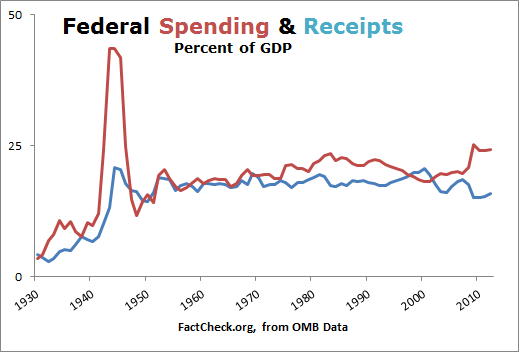
Factcheck has a chart of the relation between Federal spending and Receipts going back to 1930.  This is useful in looking at the relation between these two conditions in the national economy and what we know about the impact of various policies on the American economy.  What stands out is how heavily the United States overspent during World War II, but also that despite that heavy expenditure the economy boomed in the next several years, that is, in the 1950s.  By the current arguments promoted these days, especially by the Republican Party, the US economy should have gone into free fall after WWII.  What we know, of course, is that the building after the war, financed by borrowed money, boosted the  economy so that revenues rose sufficiently to pay off the debt.  


Another feature of this chart worth noting is that the one time the United States had a surplus -- note,  a surplus -- was toward the end of the Clinton era.  Clinton should be justly proud of that achievement.  But also note that as soon as George W Bush administration came into office they gave it away:  they cut revenues and let the debts rise.  In fact, if I understand Paul Krugman, that would have been the time actually to have paid down the debt so that the government would have been in a better position to weather any forthcoming storm; to give it away, especially to the well-to-do who scarcely needed it at the time, would seem like squandering an opportunity.  The point is, when the economy is in the doldrums spend to get it going again, then cut back when it is doing well.

What Krugman said tonight on the Newshour seems to be true:  As long as the Republicans had their man in office they didn't worry about overspending; it is merely now that the other party is in office that they have trumpeted the dangerous levels of debt.  If Romney wins then the party who squandered the last opportunity would be back in power -- I would hope not to  do it again [!].   

For what it's worth, I post the chart  here for the interest of anyone trying to figure out how they plan to fix the economy.


Saturday, June 16, 2012

"The most misguided, naive, uninformed, egregious decision of the Supreme Court"

Finally a Republican calls a spade a spade.  If any Republican is going to say what everyone else considers tragically obvious it is going to be John McCain.  Thanks, John, for saying what seems so obvious that the need to say it reveals how distorted American political discourse has become.  

He was being interviewed on The News Hour by Judy Woodruff and the problem of money in American politics came up.  Here is that part of the interview.

Judy Woodruff:  Is this … just inevitable that we're now in a period where money is going to be playing this dominant role in American politics?
SEN. JOHN MCCAIN: I'm afraid, at least for the time being, that's going to be the case, because of the most misguided, naive, uninformed, egregious decision of the United States Supreme Court I think in the 21st century [i.e., the decision on Citizens United].  To somehow view money as not having an effect on election, a corrupting effect on election, flies in the face of reality. I just wish one of them had run for county sheriff. . . .

JUDY WOODRUFF: You mean one of the justices?

SEN. JOHN MCCAIN: One of the five Supreme Court justices that voted to invalidate what we know of as McCain-Feingold.
Look, I guarantee you, Judy, there will be scandals. There is too much money washing around political campaigns today. And it will take scandals, and then maybe we can have the Supreme Court go back and revisit this issue.
Remember, the Supreme Court rules on constitutionality. So just passing another law doesn't get it. So I'm afraid we're in for a very bleak period in American politics. You know, we all talk about -- and you just did -- about how much money is in the presidential campaign.
Suppose there's a Senate campaign in a small state, and 10 people get together and decided to contribute $10 million each. You think that wouldn't affect that Senate campaign?
JUDY WOODRUFF: This question of campaign money highlighted today by this -- the announcement that there's a huge amount of money coming in from one donor in the state of Nevada.

SEN. JOHN MCCAIN: Mr. Adelson, who gave large amounts of money to the Gingrich campaign. And much of Mr. Adelson's casino profits that go to him come from this casino in Macau.

JUDY WOODRUFF: Which says what?

SEN. JOHN MCCAIN: Which says that, obviously, maybe in a roundabout way, foreign money is coming into an American campaign -- political campaigns.

JUDY WOODRUFF: Because of the profits at the casinos in Macau?

SEN. JOHN MCCAIN: Yes. That is a great deal of money. And, again, we need a level playing field and we need to go back to the realization that Teddy Roosevelt had that we have to have a limit on the flow of money, and that corporations are not people.  That's why we have different laws that govern corporations than govern individual citizens. And so to say that corporations are people, again, flies in the face of all the traditional Supreme Court decisions that we have made -- that have been made in the past.

Thursday, June 14, 2012


 Massacre and Mass Rape in Afshar (February 10-11, 1993)

Massacre and Mass Rape in Afshar (February 10-11, 1993)

AFGHANISTAN JUSTICE PROJECT
Saturday 11 February 2012

The Context of the Operation

The Afshar operation of February 1993 represented the largest and most integrated use of military power undertaken by the ISA up to that time. There were two tactical objectives to the operation. First, Massoud intended, through the operation to capture the political and military headquarters of Hizb-i Wahdat, (which was located in the Social Science Institute, adjoining Afshar, the neighborhood below the Afshar mountain in west Kabul), and to capture Abdul Ali Mazari, the leader of Hizb-i Wahdat. Second, the ISA intended to consolidate the areas of the capital directly controlled by Islamic State forces by linking up parts of west Kabul controlled by Ittihad-i Islami with parts of central Kabul controlled by Jamiat-i Islami. Given the political and military context of Kabul at the time, these two objectives (which were largely attained during the operation) provide a compelling explanation of why the Islamic State forces attacked Afshar.

Responsibility for the abuses committed during the operation

The forces that launched the offensive in west Kabul on February 10-11, 1993 all formally belonged to the ministry of defense of the ISA. The minister of defense and de facto commander-in-chief of the ISA at the time of the Afshar operation was Ahmad Shah Massoud. He had overall responsibility for planning and command of military operations. He directly controlled the Jamiat-i Islami units and indirectly controlled the Ittihad-i Islami unit. Massoud secured the participation of the Ittihad-i Islami units through agreement with Abdul Rasul Sayyaf, the leader of the party. Although the Ittihad units had been given Afghan Army formation numbers, commanders in the field took their orders from senior Ittihad commanders and Sayyaf himself. Sayyaf acted as the de facto general commander of Ittihad forces during the operation and was directly in touch with senior commanders by radio. In this sense, Sayyaf shares equal command and control responsibility with the top Jamiat military leadership.
Given the pattern of violence and ethnic tension that had preceded the operation, the general commanders could and should have anticipated the pattern of abuse that would result when launching an offensive into a densely populated Hazara majority area.. Furthermore, as fighting took place in an area barely two kilometers from the general command post, and field commanders were equipped with radio communications, the general commander must have known of the abuses taking place in Afshar as soon as they started. Both Massoud, together with his senior commanders, and Sayyaf failed to take effective measures to prevent abuses before the operation commenced, or to stop them once the operation was underway. 
While it has not been possible to identify individual commanders responsible for specific instances of execution or rape, the Afghanistan Justice Project has been able to identify a number of the commanders who led troops in the operation. Testimony indicates that both Jamiat and Ittihad troops committed abuses. Although some of the commanders were only involved in legitimate military actions, capturing and securing a designated objective, commanders who took place in the operation on the ground have a case to answer to determine whether they restrained their troops from abuses, or whether they and their men actively participated in the summary executions, rape, arbitrary detentions and other abuses that occurred during the operation.
The Islamic State, through Defense Minister Ahmad Shah Massoud and leader of factional ally, Abdul Rasul Sayyaf, committed the following military forces to participate in the Afshar operation.

Jamiat-i Islami commanders and units

Mohammad Qasim Fahim, director of intelligence, with responsibility for special operations in support of the offensive and participating in planning of the operation. Anwar Dangar, commander of a division level unit of mujahidin from Shakkar Darra, Shamali, named by numerous witnesses as leading troops in Afshar that carried out abuses on the first two days of the operation.
Mullah Izzat, commander of a division level unit of mujahidin, from Paghman, named by numerous eye witnesses as leading troops in Afshar that carried out abuses on the first two days of the operation. 
Mohammad Ishaq Panshiri, commander of a brigade level unit of mujahidin (lewa) that, according to witnesses, participated in the assault Haji Bahlol Panshiri, commander of a brigade level unit (lewa) that, according to witnesses participated in the assault Baba Jullunder Panshiri, commander of a brigade level unit (lewa) that participated in the assault Khanjar Akhund, Panshiri, commander of a battalion level unit (ghund) that participated in the assault Mushdoq Lalai, battalion level, participated in the assault Baz Mohammad Ahmadi Badakhshani, commander of a division level unit that participated in the assault, attacking from Qargha

Ittihad-i Islami commanders and units participating in the operation

Haji Shir Alam, division commander affiliated to Sayyaf, from Paghman, named by numerous eye witnesses as leading troops in Afshar on the first two days when abuses were committed 
Zulmai Tufan, commander of the Lewa 597 brigade, named by numerous eye witnesses as leading troops in Afshar on the first two days, when abuses were committed. (Lewa 597 existed before the fall of Dr. Najibullah’s government when it was called Lewa Moradat-Tank). It was in based in the Company area of west Kabul. 
Dr. Abdullah, commander of a battalion level unit (ghund) of the Lewa 597, named by several witnesses as leading troops in Afshar on day one and two, when abuses were committed Jaglan Naeem, commander of a battalion level unit (ghund) of the Lewa 597, had stationed troops in Afshar by second day of the operation 
Mullah Taj Mohammad, named as participating in planning of the operation 
Abdullah Shah, named by several witnesses as leading troops in Afshar and responsible for arbitrary arrests, abductions and other abuses. 
Khinjar, who had stationed troops in Afshar by the second day of the operation 
Abdul Manan Diwana, commander of a battalion level unit (ghund), named by witnesses as stationing troops in Afshar by the second day of the operation 
Amanullah Kochi, commander of a battalion level unit (ghund), had stationed troops in Afshar by second day of the operation 
Shirin, commander of a battalion level unit (ghund), had stationed troops in Afshar by the second day of the operation 
Mushtaq Lalai, commander of a battalion level unit (ghund), had stationed troops in Afshar by the second day of the operation
 
Mullah Kachkol, had stationed troops in Afshar by second day of the operation 

Narrative of the operation

All of the forces that ultimately participated in the fighting on February 10-11, 1993, were already deployed in and around Kabul before the start of the offensive. The main preparations made by the ISA were the conduct of special operations to weaken the Hizb-i Wahdat defenses and deployment of additional artillery for the bombardment. As director of intelligence, Mohammad Fahim had overall responsibility for special operations. His personnel contacted a number of the Shia commanders around Afshar and obtained their commitment to cooperate with the Islamic State offensive. 
The most significant new deployment of artillery before the operation was the position on Aliabad Hill. Massoud pre-positioned a Z0 23 gun there, with the detachment of 30 men, to target the area around the Central Silo, Afshar, Kart-iSeh, Kart-iChar and Kart-iSakhi. 
The main significance of the massive firepower and the large number of positions from which artillery was used is that they demonstrate the scale and significance of the operation. This was not a raid or skirmish but a full scale battle, in which the Islamic State deployed the combined military resources from the old Soviet era army and the mujahidin against targets within the capital city, all of them located in areas that were primarily residential, with the civilian population intact. 
Witnesses who were associated with the military at the time of the operation have provided accounts of the planning and military coordination that Massoud undertook prior to actually launching the operation on the ground. However, this represents only a partial view of the planning, as an operation of this scale must have involved intensive preparations. According to one witness, the top Jamiat commanders, along with selected senior Ittihad commanders (Shir Alam and Zulmai Tufan), and with the main Shia ally, Massoud Hussain Anwari, plus the ISA military advisors, met under the chairmanship of Massoud at Corps headquarters in Badambagh two days before the operation. Another meeting was held in an intelligence safe house in KartiParwan, near the Intercontinental hotel, on the night before the offensive. Massoud used the same house as an operations room for much of the day. There was also a meeting of the Ittihad commanders, under the chairmanship of Sayyaf, in Paghman, one day before the operation. The purpose of these meetings was to instruct key commanders on their role in the ground offensive.
The ISA forces commenced a generalized bombardment of west Kabul on the night of February 10-11, 1993, with targets both around the Social Science Institute and Afshar and in the rest of the Shia areas of the city. Troop movement started around 05.00 on February 11, and this is generally remembered as the time of the full commencement of the operation. The first decisive troop movement was from Badambagh to the top of the Radar Hill, part of the Afshar ridge. ISA troops were immediately able to take over positions along the top of the ridge unopposed and the main Hizb-i Wahdat defense posts there were burned and the tanks stationed there immobilized. 
A large contingent of both Ittihad and Jamiat forces advanced towards Afshar from the west. The closest point of the front line to the main target of the operation was the Kabul Polytechnic. A Jamiat force advanced along the main Afshar Road, from Kart-iParwan and the Intercontinental Hotel, towards the Social Science Institute, entering Afshar from the east. The ISA forces did not advance along other sections of the front line marking the west Kabul enclave, although they maintained an intense bombardment and had ample forces deployed to maintain a threat of advance. 
However, by 13.00 Hizb-i Wahdat’s main defense line along the Afshar ridge was gone and their hold on the Social Science Institute untenable. Mazari and his top commanders fled the Institute on foot. By 14.00 the ISA forces were able to occupy the Social Science Institute, and the forces that had advanced from the east and the west, met up in Afshar, having taken effective control of the area. They deployed in Khushal Mina and Afshar, but made no further advance. 
Troops started to secure the area, establishing posts and undertaking a search operation. It was this search operation that rapidly became a mass exercise in abuse and looting, as described in the civilian eyewitness testimony below. 
Mazari was able to order the re-establishment of the defense line along the edge of Khushhal Mina, next to the Central Silo and Kart-iSakhi, thus retaining most of the rest of west Kabul. Some of the Afshar residents, basically those considering themselves most vulnerable, managed to flee with the departing Wahdat troops (this factor seems to account for the relatively low number of male youths mentioned in the casualties in the testimony). However, the majority of the Afshar civilian population was in place as the ISA forces took over. Because of the bombardment, active fighting and presence of potentially hostile troops, it seems that many civilians were unable to leave on the first day of the operation. However, a mass exodus took place on the night of the February 11-12. Women and children fled mainly towards Taimani, in north Kabul, and they found shelter in schools and mosques in the Ismaili quarter there. Some old men elected to stay and guard houses and possessions, but testimony indicates that the troops mainly targeted men for arbitrary detention and summary execution, i.e. male civilians were not free to leave the area. Most survivors who fled Afshar described seeing debris and corpses along the way, indicating that they fled after the main battle. By the end of the second day, the bulk of the civilian population had evacuated Afshar and it seems that this exodus was the development that most decisively ended abuses against civilians in the area. 
On the second day of the operation, February 12, Massoud convened a meeting in the Hotel Intercontinental which, belatedly, discussed arrangements for security in the newly captured areas. This meeting was attended by top ISA military commanders and political figures, including Rabbani, Sayyaf, Hayatollah Mohsin, Ayatollah Fazl, and General Fahim. ISA did claim a Shia constituency and Hussain Anwari, as a senior ISA commander, was under pressure from Shia civilians to make some arrangements for their safety. The meeting ordered a halt to the massacre and looting and agreed on an exchange of envoys between the warring parties, for identification of prisoners. It also called for a withdrawal of the offensive troops, leaving a smaller force to garrison the new areas.
Given the scale of abuses that occurred on the first two days of the operation, before the meeting, it was clearly too late to prevent the main abuses. The meeting also seems to have been ineffective in halting the looting of the area, as the destruction of housing in Afshar happened largely after the meeting.

The War Crimes: Indiscriminate Attacks, Rapes, Abductions and Summary Executions

Indiscriminate Shelling and bombardment of civilian areas
The Afshar area was subjected to heavy bombardment during the first day of the operation. The principal military targets would have been the Social Science Institute and the other main Wahdat garrisons. However, the Social Science Institute was never hit. The majority of the rockets, tank shells and mortars fell in civilian residential areas. As the command centers of both the Ittihad and Jamiat forces were within site of Afshar, it appears that the attack was intended to drive the civilian population from Afshar—which it succeeded in doing. The number killed in the assault (not including those summarily executed) is not known. Virtually every witness interviewed by the Afghanistan Justice Project described seeing bodies in the area.
Indeed, the shelling and mortar fire was so intense, many residents hid on the first day, and did not try to leave. Although this may have reduced civilian casualties from the bombardment, it left these civilians vulnerable to the abuses that followed.

Bahrain's abuse of its own citizens -- with American complicity

We and most of the world rightly have condemned the Syrian government's abuse of its own people, but what about the similar situation in Bahrain?  There is a difference:  In Bahrain there is a Naval base that is crucial to the United Sates in the Gulf.  So the US tolerates the abuse of the people in Bahrain and condemns the abuse of people in Syria.  


Shame on us. 


How can the United States not  be considered complicit in these abuses of the Bahrani public?  

Bahrain has convicted its own doctors for treating the injured in public demonstrations
Bahrain convicts medics for role in uprising - Middle East - Al Jazeera English

And Bahrain has, with the rest of the world looking elsewhere, continued to abuse their own people with impunity
Bahrain: Shouting in the dark - Programmes - Al Jazeera English

Monday, June 11, 2012

The end is near?


It used to be that we had men on the street carrying boards saying, "The end is near."  Now we have Paul Krugman [today's New York Times]telling us pretty much the same thing.

"Whatever the deep roots of this paralysis, it’s becoming increasingly clear that it will take utter catastrophe to get any real policy action that goes beyond bank bailouts. But don’t despair: at the rate things are going, especially in Europe, utter catastrophe may be just around the corner."

I hope that the reason this statement resonates with me is that I have a deep neurosis:  Could a dark pessimism lurk deep in my personality?  I only hope it cannot be real.   

What I know is that I have friends from left and right who fear catastrophe ahead -- for different reasons, of course.  But when the future looks dark from starkly different angles it could actually be as bad as we fear.

What is most exasperating is how easily -- even in this perilous time -- our politicians pin  the problems of our age on the failures of each other.  Of course each one tells us, in this election year, that they know how to fix it -- without giving us details; only that they are the ones qualified to deal with the great problems of our age.   For me it is terrifying that we have to entrust our future into the hands of politicians, the same guys that got us in this mess.

This crisis -- in governance, in the economy, in the global ecology, etc -- has been brewing for at least a generation and it isn't going away easily or quickly.  At least, so I fear.  

Wednesday, June 06, 2012

Wealth votes early and often


Everyone is aware that the upcoming election will be themost expensive in history. I think the Republicans are expected to expend about a billion dollars to defeat President Obama and the Democrats hope to have about the same amount.  The recent election in Wisconsin exemplifies how costly our elections have become.  Governor Scott Walker (Republican) raised $30.5 million, about two-thirds of which came from outside the state.  Challenger Tom Barrett raised $3.9 million, 26% of which came from outside. 

The out-of-state donations seem excessive.  What did the outsiders who coughed up $20 million for Walker expect for their money?  And those who donated the $1 million for Barrett – was it worth pouring into a rat hole?  What do any donors expect for their money?  In theory the candidates may not actually know where the money comes from -- this is the way the Supreme Court thinks --but the reality has to be otherwise.  If I, for instance, give out a big sum to support a candidate, don’t I expect something of interest to me to come from it?  Walker, for instance, need not have known where those $20 million came from, but at least some of those donors – they must be mainly deep pocket donors – must surely expect something out of it.  It is reasonable to suppose that they would give bundles of money anonymously?  

The candidates in our elections must surely be in hoc to their donors, somehow.  It seems odd if a candidate has no idea of whom he/she is indebted to.  Surely the candidate knows that he has debts to pay.  If he fails to pay, if he were to displease his donor-base there is a chance they will shift their money elsewhere next time – or worse, use their largess against him next time.   For those with the money there are ways of making sure their story will be heard – we can hardly escape the TV ads, paid for, of course, by those with big money.  So Walker now has debts – and most of them outside the state.

This seems to be the way it works, and not only in Walker’s case.  We hear that most candidates for office spend much of their time on the phone begging for money – a tragic waste of the talents of anyone capable of governing a state or a country.  Once elected the candidates have big debts; big gifts mean big obligations.

We tell ourselves that we have representative government, meaning that those in office represent the will of the people who elect them, but what is the reality?  In practice elections are won by those who somehow acquire money enough to tell their stories, told the way they want them told.  Advertising matters; that’s why they spend so much hard cash on it.  The result, as in the case of Scott Walker, is that the winner takes office with a bundle of obligations, the more of them the more money they have received.  And now we hear that the obligations of those in office – or at least those who will be in office after the next election – will be humongous.  How can an elected official claim to represent everyone when in fact he/she owes thousands, perhaps millions, of dollars to the donors who helped put him in office? 

What it seems we have is elected officials whose practical obligations are to big donors.   Instead of senators representing the citizenry of their state we have senators representing large moneyed interests.  The legislative process thus entails negotiations among senators who are representing major donors (corporations or super-rich individuals).  Imagine – could it be this bad? – a senator from ExxonMoble sits down with a senator from Merk and a senator from Archer Daniels Midland and a senator from United Health Group so that they can work out their differences in writing the laws that will govern this country.  It goes without saying that no senator representing the “projects” or the underprivileged sectors of an inner city would be counted in these negotiations.
   
Folks can say that we all have a voice, and it’s true: we still have a one-person-one-vote system.  The difference is that the wealthy have bigger megaphones than the rest of us.  They get to promote their stories through huge media outlets, and of course they tell it their way – leaving out certain details and emphasizing others according to their own perspective.  They have in practice a kind of extra vote – maybe many votes, the more the more powerful their megaphone.  For most of us, our megaphones don’t reach many people. 

Our government is not as representative as we thought.  It would be nice, though, if we knew who the donors are that put the guys into office.  To whom is Scott Walker indebted?  And for that matter, I wish I knew who my senators are in hoc to.  If I knew that, I think I would understand better why they do what they do.  

Tuesday, June 05, 2012

Affordable Care Act: Issues worth noting in the search for truth


The debate about the Affordable Care Act, the health care bill enacted under Obama's leadership, has been so fierce that the actual provisions of the law have been veiled.  Also, it turns out, some of the language used to characterize it are deliberately crafted to obfuscate it.  

In an article entitled “Obama and Health Care:  The Straight Story” in the NYRB [June 21, 2012 p45-47] Jeff Madrick reviews several recent books on the Affordable Care Act.” The books he reviews are Remedy and Reaction by Paul Starr;  Inside National Health Reform by John E McDonough, and  Fighting for our Health by Richard Kirsch.

The whole article is useful but I note here some details I thought worth giving prominence to:

Some statistics on the current level of care in America:

“Except for the US, no rich nation in the world fails to provide comprehensive health care that is free or inexpensive to its entire populations.  Yet roughly 50 million Americans, 16 percent of the population have no health insurance at all…” 
“A Harvard Medical School study found that some 45,000 deaths a year are associated with lack of health insurance.” 
“Americans pay more than 17 percent of the Gross Domestic Product for their health care, more than any other rich nation by far.” 
“The US ranks forty-eighth in infant mortality among all nations, and its rank has been falling…”
Some provisions in the Affordable Care Act:
“half of the newly insured would be covered by significantly expanded Medicaid, …  The other half would be subject to an individual mandate, requiring them to sign up for at least a minimal insurance plan or pay a penalty.” [This latter provision is being reviewed by the Supreme Court] 
“the bill would also prevent health insurance companies from turning down applicants with preexisting health conditions or limiting annual benefits for those who get sick.” 
Some historical notes on who have supported such an act in the past:
“Conservatives resent the individual mandate that all Americans buy insurance, even though mandates had been a staple of Republican health care proposals since the 1970s.”  
“FDR favored universal health care … but hesitated to develop a specific plan.” 
“Harry Truman favored a national health care plan…” 
“In the 1970s Richard Nixon favored a universal health care system for all…” 
“Charles Grassley, the Republican senator from Iowa, had favored a public option during the Clinton health care debates in 1993…”
Republican strategy on how to characterize the health care bill: 
Emphasize that health care reform would “deny” care to Americans;  
Talk about “a government takeover”,  "Takeovers are like coups… They both lead to dictators and a loss of freedom.”

Thursday, May 31, 2012

Moorsom on Why NeoLiberal Policies in Africa have been Disastrous


In yesterday's issue of Al Jazeera Toby Leon Moorsom has produced a terrifying image of what's happening in Africa owing to the influence of neo-liberal economic policies -- that is, the view that free trade and open markets, and the privatization of all state-owned enterprises are always good for the public generally.  What Moorsom points out is that the way this has been applied in Africa has favored the rich and left the poor ever more worse off.  And give their desperate plight, the poor are left to finding work in fighting forces such as those connected with extremist agendas.  Whoever can command the wealth in these countries can command armies, a situation that leads to more militarism.

There is more here worth serious reflection.  By all means you should read it in full.  Merely to wheat interest I reproduce some statements that need to be examined carefully [leaving out or truncating the material evidence he provides for his claims]:

Over the past year, Africa has seen the decomposition of states from coast to coast. A belt of war, coups and large-scale spontaneous demonstrations has emerged across the Sahel, from Guinea-Bissau to Somalia. ...
These political processes have a variety of localised causes, yet they have some commonalities. All of them emerge in a context of failed agricultural markets and a boom in mineral and oil extraction.  ...
It is not a coincidence that African governments are falling apart while Europe and North America are facing financial crisis. We are witnessing the declining hegemony of African states at the same time the competition for spoils intensifies, while the potential rewards of capturing the centre become ever more valuable. Capital is not withdrawing from Africa, but instead, the processes of extraction are becoming more obvious as the economic basis of societies are under severe strain. ...
At a recent launch of The Oxford Companion to the Economics of Africa in Accra, the editors of the esteemed volume were at odds over how to assess the consequences of three decades of "Washington Consensus" neoliberal economic policies. ... [T]he only point they agreed on was the fact that they have resulted in growing inequalities and increasing poverty throughout Africa.
What we are witnessing now is, in part, the blowback from years of neoliberalism and military interventions in places such as Somalia and Libya. This blowback is revealing the shallowness of the "Third Wave" democratisation processes in Africa that the US political science establishment was so keen to ride. ...
[N]neoliberal policies [have] destroyed existing local markets while highly sinister elements flourished. ...
[M]aterial processes of extraction impact political processes. [Demonstrated by the scholarly work of Catherine Boone, Mahmood Mamdani, and Chris Allen].  ... [They have shown that ] peasant-based economies have integrative tendencies. Hegemony is more firmly rooted in land-tenure patterns and cultural institutions of labour mobilisation (ie: unpaid family labour, or working for the chief or marabout). These patterns stem from various alliances and forms of indirect-rule set in place between colonial governments and "strong men". Alternately, extractive industries around valuable commodities have greater tendency toward disintegration.
Agriculture across the region is in crisis. ...
Reforms of the 1990s battered the agricultural sector throughout Africa. Deborah Bryceson at the University of Glasgow notes how these reforms greatly expanded the productivity gap between small-scale and large-scale production. ...
Africa is experiencing the most grotesque contradictions of Europe's financial crisis. The immediate consequences in the south have been a drop in aid funding, while at the same time, the world's wealthiest are hoarding gold. ...
As declining peasant production, increased war and climate change fuel dislocation, there are fewer aid organisations to fill in the gaps for people to meet bare necessities. These people are the easiest to recruit into armies and gangs of banditry and piracy. ...
There is no doubt that many of the earth's resources are being used to create unnecessary products for high-consumption lifestyles in much of the world. The problem, however, is that ...  [c]apitalist societies are producing simply for the sake of production, not need.The current crisis of capitalism is that there is "surplus liquidity". In other words, the rich have so much wealth they have exhausted places to store it. If it is not invested its value depreciates. This is what has led to land grabbing and investment in grain futures markets. This is why we see record amounts being spent on art ... [and] why we see car companies pushing zero per cent financing. While workers are having their jobs and wages cut and governments are enforcing austerity, companies have never held so much cash. As one author reports: "Globally, companies are sitting on more than $5 trillion." This is a classic case of "over-production". When investors cannot sell more cars and condos, they turn to purchasing gold and minerals. 


Toby Leon Moorsom teaches at Queen's University in Canada and is an editor of Nokoko Journal of African Studies.
Source: Al Jazeera

Wednesday, May 30, 2012

Mann and Ornstein: It's even worse than you thought: Republicans are the problem

Paul Rosenberg, in an article in Al Jazeera, has taken note of what happens when noted commentators criticize the Republican party:  They get shut out.

He is referring to the latest book by Thomas E Mann and Norman J Ornstein, It's Even Worse Than It Looks: How the American Constitutional System Collided with the New Politics of Extremism..  Rosenberg's point is that the GOP seems to think it is OK to make extreme remarks like Allan West's slanderous claim that 78 to 81 members of the Democratic Party are card carrying Communists.  Yes, he said it, and it was crazy but his colleagues are not willing to correct him.  Mann and Ornstein are saying that the extremism is not balanced on both sides:  The Republicans have become willing to tolerate dangerously cruel extremism:  In fact, that was the title of their summary of the book in an short piece in the Washington Post:   "Let's just say it: The Republicans are the problem".  Finally someone is calling a spade a spade.

As Rosenberg points out the Democrats are in no way lily white, but the Republicans have outdone themselves in their silence when one of their own says cruel, unjust, and slanderous things about the other party.  I keep wondering how long the many good people who have always been loyal Republicans will be willing to put up with this.  The Party deserves better, but there are some extreme voices who are doing the Party no good by what they say.

Have a look at Rosenberg's interesting critique.
http://www.aljazeera.com/indepth/opinion/2012/05/201252310114193943.html

Sunday, May 27, 2012