Afghan Taliban versus Arab Taliban?
Today's report on the suicide bombings in Afghanistan by Carlotta Gall (New York Times) emphasizes how much more frequent the bombings have become, but tucked in at the end of the article is a curious detail. She says that the Taliban forces who have been operating in the Panjwai district (near Kandahar) have "tried to distance themselves from the suicide bombings that have killed civilians and damaged shops". They have posted fliers saying that outsiders ("foreign Taliban") were responsible for those attacks and they would be subject to capital punishment. This is because they are concerned about their image. Also, local villagers are blaiming "foreigners or outsiders" for the suicide bombings and that "ordinary Taliban" are merely fighting the NATO forces. She also quotes a witness of the Taniwal bombing who claims that the bomber "appeared to be an Arab." Supposition, presumably, but whether true or not, it seems clear that the "Arabs" are being blamed for the suicide bombing. And that the Taliban are divided over suicide bombing -- the typical Afghan point of view versus the militant Arab viewpoint.
RLC
Some other interesting publications in the last few days:
David Isby, an old hand in the Afghanistan wars, points out thecontradictory messages Musharraf has given out in the last few days.
A Tale of Two Pakistans: Musharraf's Dramatic Claims Unwittingly Highlight Contradictions
By DAVID ISBY
Published: September 25, 2006 (The National Interest)
President Pervez Musharraf during his visit to Washington made a series of statements dramatic enough to cheer any book publisher.
more…
Hafizullah Gardesh and Wahidullah Amani report from Kabul that the Afghan leadership is "bemused" by Musharraf's statements to the western press. I think I would use a different word: frustrated.
Afghans Bemused by Mixed Messages from Musharraf
By HAFIZULLAH GARDESH and WAHIDULLAH AMANI
Published: September 17, 2006 (Institute for War and Peace Reporting)
Islamabad is outflanking Kabul in the debate about where the Taleban are based and whose fault it is that they are still there.
more…
Massoud Ansari and Colin Freeman point out that the signature of Mullah Muhammad Omar on the Waziristan deal (between the tribes and Pakistani army) reveals how plainly in sight he is, despite the many claims that the Americans and Pakistanis have been unsuccessfully searching for him for five years!
Omar role in truce reinforces fears that Pakistan 'caved in' to Taliban
By MASSOUD ANSARI and COLIN FREEMAN
Published: September 24, 2006 (The Telegraph UK)
The fugitive Taliban commander Mullah Omar has emerged as the key player behind the movement's controversial peace deal with Pakistan.
more…
A Canadian author notes Karzai's appeal that Islamic schools "teaching hatred" should be abolished - he refers to the schools in Pakistan.
Abolish Islamic schools that teach hatred: Karzai
By DINA BEBLAWI
Published: September, 23, 2006 (Montreal AFP)
Afghan President Hamid Karzai on Saturday urged the international community to put an end to Islamic schools that teach hatred and produce suicide bombers.
more…
Helen Womack of the Daily Telegraph reports to her British audience the warning of a former Soviet Officer, that the Allied powers will suffer the same embarrassment in Afghanistan as the Red army did. Well do the British in fact know: they lost most of an army there in the mid-nineteenth century.
You will be driven from Afghanistan just as we were, Russian generals warn
By HELEN WOMACK
Published: September 24, 2006 (The Telegraph UK)
British troops will be forced to flee Afghanistan, say former Soviet commanders who oversaw Moscow's disastrous campaign against the mujahedeen in the 1980s.
more…
Barnett R. Rubin provides information from his last conversation with Hakim Taniwal before his murder by a suicide bomber.
The Death Of an Afghan Optimist
By BRNETT R. RUBIN
Published: September 17, 2006 (Washington Post)
"We lost a friend today." A suicide bomber had blown up the car of Hakim Taniwal, the governor of Paktia province on Afghanistan's frontier with Pakistan, killing him and two aides.
more…
Craig Pyes and Kevin Sack in a special article for the Los Angeles Times report on abuses of Afghans by American troops. Again, the failure to understand a foreign language trips up our men on the ground. It is tragic all around.
Two Deaths Were a 'Clue That Something's Wrong'
By CRAIG PYES and KEVIN SACK
Published: September 25, 2006 (Los Angeles Times)
A Special Forces team in Afghanistan failed to alert its superiors. Witnesses tell of torture.
more…
Wednesday, September 27, 2006
Monday, September 25, 2006
Spy Agencies Say Iraq War Worsens Terrorism Threat
A classified National Intelligence Estimate, published on the basis of leaked information on 9/24/06, has found that the American invasion and occupation of Iraq has helped spawn a new generation of Islamic radicalism. The project to assess the matter began in 2004 and was delayed until April of this year because some government officials were unhappy with earlier versions. National Intelligence Estimates are the most authoritative documents that the intelligence community produces on a specific national security issue.
The most saddening aspect of this story is that it has taken so long to say what has been so evident in the course of events. And it is not really news: it has been said before: a National Intelligence Council report completed in January 2003, two months before the Iraq invasion, said that "the approaching war had the potential to increase support for political Islam worldwide and could increase support for some terrorist objectives." The House Intelligence Committee released [9/20/06] an even more "ominous report about the terrorist threat" based on unclassified materials. It said that the jihadi movement is growing: Al Qaeda leaders are waiting "patiently for the right opportunity to attack.'" So the news is not news. For anyone paying attention to affairs in Iraq, Afghanistan and Pakistan it simply says what one could surmise from the daily reports of violence. How many more "news" reports of this sort will it take for the reality of the monstrous loss of respect for Americans to sink in?
RLC
Spy Agencies Say Iraq War Worsens Terrorism Threat
By MARK MAZZETTI
Published: September 25, 2006 (The New York Times)
A stark assessment has found that the American invasion and occupation of Iraq has helped spawn a new generation of Islamic radicalism and that the overall terrorist threat has grown since the Sept. 11 attacks.
more…
The most saddening aspect of this story is that it has taken so long to say what has been so evident in the course of events. And it is not really news: it has been said before: a National Intelligence Council report completed in January 2003, two months before the Iraq invasion, said that "the approaching war had the potential to increase support for political Islam worldwide and could increase support for some terrorist objectives." The House Intelligence Committee released [9/20/06] an even more "ominous report about the terrorist threat" based on unclassified materials. It said that the jihadi movement is growing: Al Qaeda leaders are waiting "patiently for the right opportunity to attack.'" So the news is not news. For anyone paying attention to affairs in Iraq, Afghanistan and Pakistan it simply says what one could surmise from the daily reports of violence. How many more "news" reports of this sort will it take for the reality of the monstrous loss of respect for Americans to sink in?
RLC
Spy Agencies Say Iraq War Worsens Terrorism Threat
By MARK MAZZETTI
Published: September 25, 2006 (The New York Times)
A stark assessment has found that the American invasion and occupation of Iraq has helped spawn a new generation of Islamic radicalism and that the overall terrorist threat has grown since the Sept. 11 attacks.
more…
Thursday, September 21, 2006
Experienced and Callous: Experts in Wasting Lives
The suicide bombing industry is flourishing. On September 18 in three different places in Afghanistan people were killed by these bombers. In a town near Kandahar Canadian soldiers were handing out pens and notebooks to excited children when a suicide bomber rode up on a bicycle into the middle of the crowd, and detonated his device. "Witnesses ... say the crowd of children gathered around the Canadian soldiers were laughing and shouting as they jostled for the gifts." Four soldiers were killed, and dozens of the children were injured.
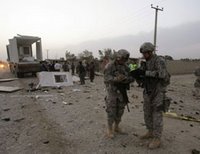 A suicide bomber in Herat killed 11 people and wounded 18. He was apparently targeting a high-ranking police official who escaped unharmed. Four of the dead were police officers; one of them was a child. Another suicide blast killed three Afghan policemen in the capital Kabul.
Suicide bombing is new in Afghanistan, but we are told that the number of these attacks in southern Afghanistan has risen four-fold this year. The practice has been rare in Somalia also, but at about the same time as these bombings a bomber killed five people there; it was just after someone shot a nun who had been serving the sick in Africa for 38 years; she died uttering, "I forgive".
The fingerprints of experienced hands are all over these killings. Suicide bombing has been a practice in the Middle East for a long time; in that context it seems to have become a science. On the same day as the above events a bomber in Iraq killed himself and 20 others in a crowded market, and another killed 13 people at a police recruitment center. For those behind it, it was just another day. Iraq, the Middle East: they have had to bear this for a long while.
I still wonder: Who would train bombers to deliberately kill children? To what purpose? What could they be thinking? What could they want? What kind of world would they create? And where does the money come from?
We are told that in the case of the Taliban these measures reveal desperation. They are now throwing themselves into battle and losing their lives in great numbers. How many of them will have to die before their handlers become ashamed of the carnage?
RLC
NATO Soldiers in Afghanistan Killed in Suicide Bomb Attack
By: BARNEY PORTER
Published: September 19, 2006 (AM Australia)
It was a small moment when the campaign to win hearts and minds in Afghanistan was working. Canadian soldiers were handing out pens and notebooks to excited children in a village in the country's south, a day after NATO had declared the area free of Taliban insurgents.
more…
Several Killed in Three Suicide Bomb Atacks
Published: September 19, 2006 (Gulf Times)
A suicide bomb exploded in Afghanistan's western city of Herat yesterday, killing 11 people and wounding 18, a hospital deputy director said.The blast struck outside the city's main mosque and appeared targeted at a high-ranking police official who escaped unharmed, police said.
more…
Somalia's First Suicide Bomb Misses President
By: STEVE SCHIPPERT
Published: September 18, 2006 (ThreatsWatch)
President Abdullahi Yusuf survived an assassination attempt as Somali leader escapes suicide attack" Somalia’s first suicide bomb attack saw a bomb-laden car drive into Yusuf’s motorcade as he left the Somali parliament.
more…
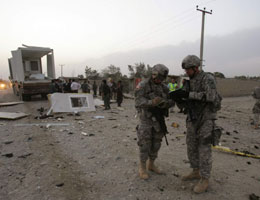 A suicide bomber in Herat killed 11 people and wounded 18. He was apparently targeting a high-ranking police official who escaped unharmed. Four of the dead were police officers; one of them was a child. Another suicide blast killed three Afghan policemen in the capital Kabul.
Suicide bombing is new in Afghanistan, but we are told that the number of these attacks in southern Afghanistan has risen four-fold this year. The practice has been rare in Somalia also, but at about the same time as these bombings a bomber killed five people there; it was just after someone shot a nun who had been serving the sick in Africa for 38 years; she died uttering, "I forgive".
The fingerprints of experienced hands are all over these killings. Suicide bombing has been a practice in the Middle East for a long time; in that context it seems to have become a science. On the same day as the above events a bomber in Iraq killed himself and 20 others in a crowded market, and another killed 13 people at a police recruitment center. For those behind it, it was just another day. Iraq, the Middle East: they have had to bear this for a long while.
I still wonder: Who would train bombers to deliberately kill children? To what purpose? What could they be thinking? What could they want? What kind of world would they create? And where does the money come from?
We are told that in the case of the Taliban these measures reveal desperation. They are now throwing themselves into battle and losing their lives in great numbers. How many of them will have to die before their handlers become ashamed of the carnage?
RLC
NATO Soldiers in Afghanistan Killed in Suicide Bomb Attack
By: BARNEY PORTER
Published: September 19, 2006 (AM Australia)
It was a small moment when the campaign to win hearts and minds in Afghanistan was working. Canadian soldiers were handing out pens and notebooks to excited children in a village in the country's south, a day after NATO had declared the area free of Taliban insurgents.
more…
Several Killed in Three Suicide Bomb Atacks
Published: September 19, 2006 (Gulf Times)
A suicide bomb exploded in Afghanistan's western city of Herat yesterday, killing 11 people and wounding 18, a hospital deputy director said.The blast struck outside the city's main mosque and appeared targeted at a high-ranking police official who escaped unharmed, police said.
more…
Somalia's First Suicide Bomb Misses President
By: STEVE SCHIPPERT
Published: September 18, 2006 (ThreatsWatch)
President Abdullahi Yusuf survived an assassination attempt as Somali leader escapes suicide attack" Somalia’s first suicide bomb attack saw a bomb-laden car drive into Yusuf’s motorcade as he left the Somali parliament.
more…
Wednesday, September 20, 2006
"Extraordinary Rendition" of an Innocent Man
I have been deeply grieved by this brutality which is relevant and troubling.
RLC
Canadian Was Falsely Accused, Panel Says
By DOUG STRUCK
Published: September 19, 2006 (The Washington Post)

TORONTO, Sept. 18 - Canadian intelligence officials passed false warnings and bad information to American agents about a Muslim Canadian citizen, after which U.S. authorities secretly whisked him to Syria, where he was tortured, a judicial report found Monday.
more...
RLC
Canadian Was Falsely Accused, Panel Says
By DOUG STRUCK
Published: September 19, 2006 (The Washington Post)

TORONTO, Sept. 18 - Canadian intelligence officials passed false warnings and bad information to American agents about a Muslim Canadian citizen, after which U.S. authorities secretly whisked him to Syria, where he was tortured, a judicial report found Monday.
more...
Monday, September 18, 2006
Tribal Militias in Both Pakistan and Iraq?

Curiously, the deals that have just been made in Pakistan and Iraq with their respective tribal elements seem very similar:
Pakistan's deal is with the Pushtun tribes in its Federally Administered Tribal Areas (but not with its Baluch tribes, as indicated earlier), and Iraq's is with the Arab Bedawin tribes of al-Anbar province. In both cases, the deal seems to entail the local tribes' agreeing to control "insurgents" (who are presumed to be outsiders and Arab). And it appears in both cases that the deal represents an admission by the respective governments that they are not getting control of the situation in those tribal areas. I have already expressed doubt that anything much will come of the deal in Pakistan. Juan Cole has similar doubts about the deal in Iraq:"Some tribes may develop feuds with some fundamentalists, but the likelihood of it amounting to much on a province-wide scale strikes me as low" (Informed Comment, 9/18/06).
RLC
Iraq Chiefs Vow to Fight al-Qaeda
Published: September 18, 2006 (BBC)
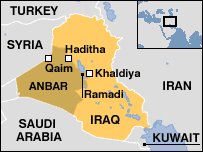
Iraqi tribal chiefs in the so-called Sunni Triangle have agreed to join forces to fight al-Qaeda, and have pleaded for US supplies of arms. One leader said tribes in the city of Ramadi had assembled 20,000 men "ready to purge the city of these infidels". Ramadi, in Anbar province, is one of the cities at the heart of the Sunni rebellion against US troops and Iraqis.
more…
Pakistan 'Taleban' in Peace Deal
Published: September 5, 2006 (BBC)
Pakistan has signed a deal with pro-Taleban militants on the Afghan border aimed at ending years of unrest. The North Waziristan accord calls on tribesmen to expel foreign militants and end cross-border attacks in return for a reduced military presence.
more…
Friday, September 15, 2006
Iran: Know Thine Enemy
Bill Berkeley's experience in Mashhad reveals something more about Iran than we can get from the normal sources. One of the most heartening things about his long article on his experience is that the Americans are still welcomed. This comports with what we have heard from others. (And with Liza Baron's report on her experience in Syria.) A member of the Basij militia was proud to have him in his home - and in one of the most conservative cities in Iran. He notes that there seems to be a "challenge of getting it right on Iran." Even though anthropologists were all over Iran in the 1970s they didn't see the Iranian Revolution coming. And again "few American reporters anticipated the election … of Ahmadinejad". We have tended to read too much in what Safdari had called "the gilded youth" who are scornful of those who voted for Ahmadinejad. Steve Coll points out in Ghost Wars to us that in the 1970s the CIA passed by the tables of cassette tapes of sermons by radical clerics all over the Middle East and went to talk to the elite who spoke western languages and paid no attention to what the ordinary public was reading and listening to. Owing to the new issues over nuclear power new concerns are being expressed about Iran, but "on the street" the picture is very different.
RLC
Iran: Know Thine Enemy
By BILL BERKELEY
Published: September 14, 2006 (Columbia Journalism Review)
On a reporting trip to Iran in the spring of 2004, I visited the northeastern city of Mashhad. It's an important pilgrimage destination for Shiite Muslims, a sprawling, low-slung metropolis that fans out from a central plaza built around the gold-domed shrine of the Imam Reza. Imam Reza is believed to have hailed from the family of the prophet Mohammad. He was designated the eighth of the twelve sacred imams of the Shi'a faith, and is the only one buried in Iran. Hundreds of thousands of devout Shiites from across south Asia and the Arab world make pilgrimages to Mashhad each year to worship inside this splendid compound of aqua-tiled spires and arches, luminous chandeliers, and gushing fountains under two glittering domes.
more…
RLC
Iran: Know Thine Enemy
By BILL BERKELEY
Published: September 14, 2006 (Columbia Journalism Review)
On a reporting trip to Iran in the spring of 2004, I visited the northeastern city of Mashhad. It's an important pilgrimage destination for Shiite Muslims, a sprawling, low-slung metropolis that fans out from a central plaza built around the gold-domed shrine of the Imam Reza. Imam Reza is believed to have hailed from the family of the prophet Mohammad. He was designated the eighth of the twelve sacred imams of the Shi'a faith, and is the only one buried in Iran. Hundreds of thousands of devout Shiites from across south Asia and the Arab world make pilgrimages to Mashhad each year to worship inside this splendid compound of aqua-tiled spires and arches, luminous chandeliers, and gushing fountains under two glittering domes.
more…
Wednesday, September 13, 2006
The Duplicity of Pakistan's "Tribal" Policy
I have come to admire the editors of The Friday Times (Pakistan) because they have continued to articulate the truth as they see it, despite the disapproval of the government, even to the point of (in more than one instance) going to jail. Because this weekly is not easily available to many people in this country I quote extensively from a recent article exposing the contradictions in Musharraf's policies: clamp down on the Baluch insurrection, give the Pushtun tribes a free reign. It is precisely the withdrawal of Pakistan's army from the Pushtun tribal area of Waziristan that Hakim Taniwal (killed a couple days ago, see my earlier entries on him) worried about: It would give the Taliban and Al Qaeda relief from military pressure so that they could concentrate on the damage they could do across the border in Afghanistan. He was right, and he was one of their targets. But as I indicated earlier, the army was not doing well in Waziristan: it is a rough place to fight a war. Baluchistan is easier and also the stakes for the Pakistan government are larger: gas well is there and the new, brand new, port at Gwadar is in place. So Musharraf had to deploy his resources where it would help him and the Pakistan government most. The result is to leave in place the Taliban-infested Pushtun areas. In the article quoted from below Sethi calls his bluff. Note that the popularity of the "mullahs" ["fundamentalists"] in the survey was no greater than 7%.
RLC
State of the Nation
By NAJAM SETHI
Published: September 8, 2006 (The Friday Times)
What follows is a summation of the article "State of the Nation"
"The writ of the state", thunders General Pervez Musharraf, "shall be enforced at all costs in Balochistan where tribalism stands abolished". Then he blithely surrenders the same dubious writ of the state to resurgent Talibanism and entrenched tribalism in Waziristan and celebrates the retreat of the state as a "historic breakthrough". The truth is that General Musharraf is selling pure opportunism as principled constitutionalism. Â…A May 2006 public opinion survey conducted in Pakistan by the International Republican Institute, a reputable research organization of the US Republican Party of General Musharraf's best friend, President Bush, revealed that 66% percent of all Pakistanis wanted their exiled leaders Benazir Bhutto and Nawaz Sharif back in Pakistan to contest the next general elections. Indeed, 77% thought that Pakistan needed a strong but popular leader - General Musharraf seems 'strong' by virtue of his uniform but he has admitted his popularity is waning, most respondents in the survey think he shouldn't be army chief and president at the same time, and Ms Bhutto (18%) leads the pack for primeministership. Most interestingly, 60% want a parliamentary system instead of a presidential system, a majority believes that General Musharraf's regime will not hold free and fair elections, and only 7% will want to vote for the mullahs and religious parties.Â…[H]e refuses to extricate himself from the clutches of the unpopular mullahs and embrace the popular political parties, he insists on strong presidential powers in a weak parliamentary system,Â…. The state has to sincerely enable the exiled popular political leaders to return and give them a transparent and level playing field in the next elections under a neutral caretaker government.
RLC
State of the Nation
By NAJAM SETHI
Published: September 8, 2006 (The Friday Times)
What follows is a summation of the article "State of the Nation"
"The writ of the state", thunders General Pervez Musharraf, "shall be enforced at all costs in Balochistan where tribalism stands abolished". Then he blithely surrenders the same dubious writ of the state to resurgent Talibanism and entrenched tribalism in Waziristan and celebrates the retreat of the state as a "historic breakthrough". The truth is that General Musharraf is selling pure opportunism as principled constitutionalism. Â…A May 2006 public opinion survey conducted in Pakistan by the International Republican Institute, a reputable research organization of the US Republican Party of General Musharraf's best friend, President Bush, revealed that 66% percent of all Pakistanis wanted their exiled leaders Benazir Bhutto and Nawaz Sharif back in Pakistan to contest the next general elections. Indeed, 77% thought that Pakistan needed a strong but popular leader - General Musharraf seems 'strong' by virtue of his uniform but he has admitted his popularity is waning, most respondents in the survey think he shouldn't be army chief and president at the same time, and Ms Bhutto (18%) leads the pack for primeministership. Most interestingly, 60% want a parliamentary system instead of a presidential system, a majority believes that General Musharraf's regime will not hold free and fair elections, and only 7% will want to vote for the mullahs and religious parties.Â…[H]e refuses to extricate himself from the clutches of the unpopular mullahs and embrace the popular political parties, he insists on strong presidential powers in a weak parliamentary system,Â…. The state has to sincerely enable the exiled popular political leaders to return and give them a transparent and level playing field in the next elections under a neutral caretaker government.
Tuesday, September 12, 2006
The Industry from Hell

A suicide bomber killed Hakim Taniwal and two colleagues two days ago, and then at his funeral yesterday another suicide bomber killed seven more, including two boys aged 10 and 12, maiming forty more. Suicide bombing is not typically Afghan; it is an import from elsewhere. And it is not Islamic. But wherever it was invented it was never natural; it is a cultural product: it has to be produced. And as a cultural product it is never the only possible solution to a situation.
It is now an industry: Suicide bombing has come to be practiced - not just as an occasional act of a few (as in London) but as a way of life -in several places: Palestine/Israel, Iraq, Afghanistan/Pakistan, Kashmir; and it seems to have been practiced in such places as India, Sri Lanka, Indonesia, the Philippines.
For such an industry to exist it has to be conceived and formulated, discussed, promoted. People have to meet and plan and organize. Funds have to be provided. Buildings have to be built or rented for training, teachers have to be trained, explosives and equipment have to be bought and collected, photographs and videos of "martyrs" have to be made, copied, circulated, promoted. Children have to be socialized over a period of years - that is, fed, housed, clothed, trained, taught to believe that to blow themselves up is the highest form of spiritual service. Officials have to turn a blind eye; neighbors have to remain silent. Hundreds of people, perhaps thousands, are implicated in this practice. Although secluded, it is not being done in a corner.
Some crimes are so heinous that one recoils from even describing them. It is too easy to condemn - can this be ourselves? Human beings? What an image of humanity is displayed in such hideous practices. We pray for God to save us from such a scourge. But I also pray for the whole industry with all its ugliness to be exposed for what it is. The ancient wisdom is still true: "men love darkness because their deeds are evil and they will not come into the light lest their deeds be exposed." And a voice with terrifying authority still speaks to the authors of such monstrous practices: "Woe to you teachers of the law ... for you traverse sea and land to make a single disciple and when he becomes a disciple you make him twice as much a child of hell as yourselves."
RLC
Monday, September 11, 2006
Musharraf - Karzai Forum
What follows is someone's summary of the public statements by Musharraf and Karzai after their conference on September 7. Note that Musharraf spoke for 70 minutes -- it must have been a huge drain on the attention span of those present. Karzai spoke for 15 minutes only. There are many interesting details here, reflecting the ways that the two leaders see the world. Musharraf offers to help build a railway from Quetta to Kandahar. A rail system in Afghanistan is inevitable; will it really materialize now? And for it to come into Kandahar, where it is much easier and from where it can continue on to Herat [not Kabul] will be much easier and of course from there into the ex-Soviet Central Asian states, mainly Turkmenistan? -- that will shift the transport focus from Kabul to Kandahar. A road to Jalalabad will be on the way to Kabul, but a railroad will be much more difficult and expensive. Musharraf also renounces support for the Taliban. And for Al Qaeda. We'll see.
RLC
Musharraf - Karzai Forum
Ø Afghanis and Pakistanis need each other more than ever before – there is no other option.
Ø There is a need to turn our region into a Tiger economy and this can only happen in the environment of peace and stability.
Ø We need to establish an economic zone in Central Asia /South Asia. Pakistan is willing to help in the following areas:
o Railway link between Quetta and Kandahar
o Jalalabad – Peshawar Road
o Health Sector
Ø He acknowledged Pakistani support of the Mujahideen and then the Taleban (up until 9/11). Pakistan had a need to support the Taleban.
Ø Pakistan no longer sees the Taleban representing the Pashtoons.
Ø We have to somehow forget the past and look to the future.
Ø Pakistan's historical ties to Afghanistan ie Jihad, refugees etc
Ø Afghans continue to blame the Pakistanis for their woes. He is saddened by this accusation as this is not true.
Ø Pakistan would be a fool to support the Taleban as they totally oppose the Talebanisation of their country (like Afghanistan)
Ø No doubts that Al Qaeda / Taleban are active in Pakistan. As they are in Afghanistan.
Ø Pakistan is against terrorism as
a) it will help in the Talebanisation of Pakistan
b) it goes against its `coalition' agenda and
c) it will decrease the likelihood of economic development (or economic zone mentioned above).
Ø Pakistan has limitations in controlling/clamping down on these groups because of a lack of
a) capacity and
b) capability.
Ø Afghans should not doubt the intentions of Pakistan.
Ø Don't blame us for what is going inside of Afghanistan.
Ø Pakistan is willing to wire the border areas (an experience that has worked well between India and Pakistan)
Ø The people of Pakistan too blame Afghanistan for
a) internal Pakistani strife
b) Baloochistan
c) training camps inside of Afghanistan and
d) foreign powers attempting to destabilise Pakistan (meaning India).
Ø Both nations should stop this blame game.
Ø We need to fight terrorism together.
Ø We need to remain united in this fight (blaming each other will lead to defeat)
Ø We need to look at each other's allegations and then eliminate them.
Ø Pakistan acknowledges that there are hundreds of Al Qaeda (foreign) members operating out of Pakistan's major cities ie Lahore, Rawalpindi, Karachi etc. Already many have been arrested and locked up (some kicked out of the country).
Ø The Taleban are different as:
o They have roots
o They have command structures
o They have better organisation
Ø There are three types of Taleban:
o Moderate religious types (extremists but not terrorists)
o Hard core Taleban
o Charsi Taleban (thugs who are now Talebs) – `Charsi' means hashish smoker
Ø Tactics are adopted to win battles while strategies are utilised to win wars
Ø Pakistan favours talking to the moderate Pashtoons (in order to get them onside so that they fight the Taleban) while isolating the more extremist elements within the group. Pakistan's strategy will entail:
o Defeating the Taleban militarily
o Bolstering its civil administrations in the hot spots
o Raise agency councils through tribal chiefs (or Maliks)
o Massive economic development projects
o Political solutions – cited the recent appointment of General Orakzai (briefly mentioned that locals are tired of fighting in Wazirstan)
Ø Recent agreement (in Wazirstan) entails:
o The expulsion of foreigners from these regions.
o No training camps
o No Taleban infiltration into Afghanistan
Ø Longer term strategy should be to find the root causes of terrorism
Ø Short term strategies will include:
o Curtailing the use of loud speakers that spread hate
o Stopping hate literature ie night letters
o Having a comprehensive Islamic curriculum at school
o Reforming the Madrassa system.
KARZAI'S RESPONSE (15 OR SO MINUTES) INCLUDED:
Ø Afghans remain appreciative of Pakistan's hospitality during the Jihad years
Ø Our intention is to have a peaceful and brotherly relations with our Pakistani neighbours
Ø Afghans will never allow foreign elements or regimes to use the Afghan soil for anti Pakistani activity (or incursions into Pakistan)
Ø The Taleban don't represent the Pashtoons – on both sides of the border
Ø Afghans are happy about the deal between the Pakistani gov.'t and N. Wazirstan Taleban – in particular as it may stop Taleban incursions into Afghanistan.
Ø Recognition of the need for stronger ties between the two countries.
Ø We are hurt by extremist activity.
Ø We are seeking Pakistan's assistance as a brother.
RLC
Musharraf - Karzai Forum
Ø Afghanis and Pakistanis need each other more than ever before – there is no other option.
Ø There is a need to turn our region into a Tiger economy and this can only happen in the environment of peace and stability.
Ø We need to establish an economic zone in Central Asia /South Asia. Pakistan is willing to help in the following areas:
o Railway link between Quetta and Kandahar
o Jalalabad – Peshawar Road
o Health Sector
Ø He acknowledged Pakistani support of the Mujahideen and then the Taleban (up until 9/11). Pakistan had a need to support the Taleban.
Ø Pakistan no longer sees the Taleban representing the Pashtoons.
Ø We have to somehow forget the past and look to the future.
Ø Pakistan's historical ties to Afghanistan ie Jihad, refugees etc
Ø Afghans continue to blame the Pakistanis for their woes. He is saddened by this accusation as this is not true.
Ø Pakistan would be a fool to support the Taleban as they totally oppose the Talebanisation of their country (like Afghanistan)
Ø No doubts that Al Qaeda / Taleban are active in Pakistan. As they are in Afghanistan.
Ø Pakistan is against terrorism as
a) it will help in the Talebanisation of Pakistan
b) it goes against its `coalition' agenda and
c) it will decrease the likelihood of economic development (or economic zone mentioned above).
Ø Pakistan has limitations in controlling/clamping down on these groups because of a lack of
a) capacity and
b) capability.
Ø Afghans should not doubt the intentions of Pakistan.
Ø Don't blame us for what is going inside of Afghanistan.
Ø Pakistan is willing to wire the border areas (an experience that has worked well between India and Pakistan)
Ø The people of Pakistan too blame Afghanistan for
a) internal Pakistani strife
b) Baloochistan
c) training camps inside of Afghanistan and
d) foreign powers attempting to destabilise Pakistan (meaning India).
Ø Both nations should stop this blame game.
Ø We need to fight terrorism together.
Ø We need to remain united in this fight (blaming each other will lead to defeat)
Ø We need to look at each other's allegations and then eliminate them.
Ø Pakistan acknowledges that there are hundreds of Al Qaeda (foreign) members operating out of Pakistan's major cities ie Lahore, Rawalpindi, Karachi etc. Already many have been arrested and locked up (some kicked out of the country).
Ø The Taleban are different as:
o They have roots
o They have command structures
o They have better organisation
Ø There are three types of Taleban:
o Moderate religious types (extremists but not terrorists)
o Hard core Taleban
o Charsi Taleban (thugs who are now Talebs) – `Charsi' means hashish smoker
Ø Tactics are adopted to win battles while strategies are utilised to win wars
Ø Pakistan favours talking to the moderate Pashtoons (in order to get them onside so that they fight the Taleban) while isolating the more extremist elements within the group. Pakistan's strategy will entail:
o Defeating the Taleban militarily
o Bolstering its civil administrations in the hot spots
o Raise agency councils through tribal chiefs (or Maliks)
o Massive economic development projects
o Political solutions – cited the recent appointment of General Orakzai (briefly mentioned that locals are tired of fighting in Wazirstan)
Ø Recent agreement (in Wazirstan) entails:
o The expulsion of foreigners from these regions.
o No training camps
o No Taleban infiltration into Afghanistan
Ø Longer term strategy should be to find the root causes of terrorism
Ø Short term strategies will include:
o Curtailing the use of loud speakers that spread hate
o Stopping hate literature ie night letters
o Having a comprehensive Islamic curriculum at school
o Reforming the Madrassa system.
KARZAI'S RESPONSE (15 OR SO MINUTES) INCLUDED:
Ø Afghans remain appreciative of Pakistan's hospitality during the Jihad years
Ø Our intention is to have a peaceful and brotherly relations with our Pakistani neighbours
Ø Afghans will never allow foreign elements or regimes to use the Afghan soil for anti Pakistani activity (or incursions into Pakistan)
Ø The Taleban don't represent the Pashtoons – on both sides of the border
Ø Afghans are happy about the deal between the Pakistani gov.'t and N. Wazirstan Taleban – in particular as it may stop Taleban incursions into Afghanistan.
Ø Recognition of the need for stronger ties between the two countries.
Ø We are hurt by extremist activity.
Ø We are seeking Pakistan's assistance as a brother.


Hakim Taniwal
September 11, 2006
The memory of losses on this date five years ago is now overlaid with grief and shame at what our leaders did with the goodwill the world had for us at that moment. In Iran they had vigils in memory of the people lost in the World Trade Center, and all across the world there was broad sympathy for what our country had experienced. Now it is gone. Not only our wealth and the lives of many brave Americans (not to mention the many innocent civilians) but also the world's sympathy, trust, and respect have been squandered. God help us.
On September 10 Hakim Taniwal, governor of Paktia province in Afghanistan was killed by a suicide bomber. I met him when he was involved in the Afghan Writers Union in Peshawar. He was a sociologist and used his knowledge to write
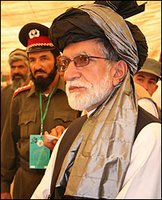 about the Afghanistan situation in critiques of the Afghanistan Communist regime, mostly in Pushtu. He was one of the few scholars who did not leave the area for better opportunities elsewhere. He stayed, along with several other scholars, to represent the war effort as a scholar.
The times were different when I knew him. The Soviets were pulling out their troops and the Afghanistan peoples were exultant. But the mujahedin organizations were on the verge of fighting each other, creating such confusion and grief that the Taliban defeat of the mujahedin would be welcomed a few years later, in the mid-1990s. Taniwal went to Australia in disgust. When Karzai was made provisional head of the Afghanistan government in 2002 he turned to Taniwal as well as other progressives to help him. Taniwal served the new government as governor of Khost, then as Minister of Mines, and in the present post - replacing a particularly culpable "warlord" - in Paktia.
There have been 47 suicide bombings in Afghanistan this year. The name of the one who killed Taniwal is unknown to those on the government's side, but there is no doubt that his name is known and valorized somewhere, probably just across the border in Waziristan. Somewhere there is a place where the pictures of "martyrs" are displayed and their stories told as great exploits in the name of God; videos made by them before their deaths are available. They will be shown to another generation of young men eager to serve God. From this "hero" they will learn how they can give their best, their all for God.
RLC
Hakim Taniwal
By GORDON ADAM
Published: September 12, 2006 (The Herald)
Governor Hakim Taniwal, who died aged 63 on September 10 in a suicide bombing outside his office in Gardez, Paktia, was very different from the caricature of a rugged Afghan tribal leader.
A sociology professor, educated in Germany and fluent in five languages, Dr Taniwal was a gentle Afghan intellectual with the courage to instil order and spearhead development in the lawless Paktia province, bordering Pakistan.
more…
The memory of losses on this date five years ago is now overlaid with grief and shame at what our leaders did with the goodwill the world had for us at that moment. In Iran they had vigils in memory of the people lost in the World Trade Center, and all across the world there was broad sympathy for what our country had experienced. Now it is gone. Not only our wealth and the lives of many brave Americans (not to mention the many innocent civilians) but also the world's sympathy, trust, and respect have been squandered. God help us.
On September 10 Hakim Taniwal, governor of Paktia province in Afghanistan was killed by a suicide bomber. I met him when he was involved in the Afghan Writers Union in Peshawar. He was a sociologist and used his knowledge to write
 about the Afghanistan situation in critiques of the Afghanistan Communist regime, mostly in Pushtu. He was one of the few scholars who did not leave the area for better opportunities elsewhere. He stayed, along with several other scholars, to represent the war effort as a scholar.
The times were different when I knew him. The Soviets were pulling out their troops and the Afghanistan peoples were exultant. But the mujahedin organizations were on the verge of fighting each other, creating such confusion and grief that the Taliban defeat of the mujahedin would be welcomed a few years later, in the mid-1990s. Taniwal went to Australia in disgust. When Karzai was made provisional head of the Afghanistan government in 2002 he turned to Taniwal as well as other progressives to help him. Taniwal served the new government as governor of Khost, then as Minister of Mines, and in the present post - replacing a particularly culpable "warlord" - in Paktia.
There have been 47 suicide bombings in Afghanistan this year. The name of the one who killed Taniwal is unknown to those on the government's side, but there is no doubt that his name is known and valorized somewhere, probably just across the border in Waziristan. Somewhere there is a place where the pictures of "martyrs" are displayed and their stories told as great exploits in the name of God; videos made by them before their deaths are available. They will be shown to another generation of young men eager to serve God. From this "hero" they will learn how they can give their best, their all for God.
RLC
Hakim Taniwal
By GORDON ADAM
Published: September 12, 2006 (The Herald)
Governor Hakim Taniwal, who died aged 63 on September 10 in a suicide bombing outside his office in Gardez, Paktia, was very different from the caricature of a rugged Afghan tribal leader.
A sociology professor, educated in Germany and fluent in five languages, Dr Taniwal was a gentle Afghan intellectual with the courage to instil order and spearhead development in the lawless Paktia province, bordering Pakistan.
more…
Friday, September 08, 2006
Pakistan "Taliban" in Peace Deal
"Pakistan has signed a deal with pro-Taleban militants on the Afghan border aimed at ending years of unrest. ...The North Waziristan accord calls on tribesmen to expel foreign militants and end cross-border attacks in return for a reduced military presence." "Local Taleban supporters, ...have pledged not tharborur foreign militants, launch cross-border raids or attack Pakistani government troops or facilities." "Observers say meeting these conditions could be difficult, as the Taleban has support on both sides of the Pakistan-Afghan border."
Everyone seems to see this as an exit strategy for the Pakistani army. And for good reason, there is abundant doubt about whether this will really accomplish anything. The statement by the Afghanistan foreign minister implies that support for the Taliban and Al-Qaida is not limited to Waziristan: "I think it is [in] a lot of other places in our region and a lot of organizationsns and also madrassas [religious schools], that they are the centre of terrorist activity." Indeed some of the most important figures in the organization have been caught elsewhere in Pakistan. And we are hearing that support for them is broadening among the Pakistani citizenry: "a lot of other places -- and a lot of organizations" he says. He specifically points to the madrassas and implies that they are at least one "center of terrorist activity." If he is right, then this deal accomplishes very little, except give the army an excuse to bow out.
The Pakistanis have lost 500 men in attempting to get control of the tribal areas. This is a frontier area between south Asia and Afghanistan, notable for its rugged terrain (it looks like a washboard from the air), as long as the distance from Maine to Georgia, where attempts at sustained control by outsiders, the British earlier and now the Pakistanis, was unfeasible. I had thought that this time, in the era of modern warfare, the Pakistanis would finally get direct control. But it has been too costly.
We can only surmise the nature of the difficulty. When we used to travel through the Khybar pass I would try to find a place along the road that was not covered by a line of fire from at least two directions. I never found a place that was not covered by fire from at least two established, secured positions above the road. Also, the road was already supplied with huge cement blocks that could easily be moved into position to barricade the highway; it would have been easy to shut down all traffic. These fortifications were first developed in British times and no doubt the Pakistanis have maintained them. I have not been further than the northern edge of Waziristan but I surmise that the passes into that area are similarly secured: I suppose that the Pakistani army's problem was multiple installations along the lines of access that covered every point. The Waziri tribesmen would have planned ways of shutting down an army trying to move into the area. And now, after 30 years of war, they are armed with the latest weaponry. The old muzzle-loading jazaeels that once did so much damage to the British and the Lee Enfield rifles of WWI times have been replaced by AK-47s.
Moreover, scarcely anyone believes that Pakistan is fully committed to rooting out the Taliban. The New York Times [9/7/06] quotes an American intelligence source that Pakistanis are still actively supporting the Taliban raids into Afghanistan: "Pakistani intelligence agents have provided intelligence to the Taliban about coalition plans and tactical operations ...". They have also provided support, housing and security for the Taliban leadership, including Mullah Muhammad Omar, and it is believed that they are providing money and weapons for their attacks on Afghanistan.
Not a good sign.
RLC
Everyone seems to see this as an exit strategy for the Pakistani army. And for good reason, there is abundant doubt about whether this will really accomplish anything. The statement by the Afghanistan foreign minister implies that support for the Taliban and Al-Qaida is not limited to Waziristan: "I think it is [in] a lot of other places in our region and a lot of organizationsns and also madrassas [religious schools], that they are the centre of terrorist activity." Indeed some of the most important figures in the organization have been caught elsewhere in Pakistan. And we are hearing that support for them is broadening among the Pakistani citizenry: "a lot of other places -- and a lot of organizations" he says. He specifically points to the madrassas and implies that they are at least one "center of terrorist activity." If he is right, then this deal accomplishes very little, except give the army an excuse to bow out.
The Pakistanis have lost 500 men in attempting to get control of the tribal areas. This is a frontier area between south Asia and Afghanistan, notable for its rugged terrain (it looks like a washboard from the air), as long as the distance from Maine to Georgia, where attempts at sustained control by outsiders, the British earlier and now the Pakistanis, was unfeasible. I had thought that this time, in the era of modern warfare, the Pakistanis would finally get direct control. But it has been too costly.
We can only surmise the nature of the difficulty. When we used to travel through the Khybar pass I would try to find a place along the road that was not covered by a line of fire from at least two directions. I never found a place that was not covered by fire from at least two established, secured positions above the road. Also, the road was already supplied with huge cement blocks that could easily be moved into position to barricade the highway; it would have been easy to shut down all traffic. These fortifications were first developed in British times and no doubt the Pakistanis have maintained them. I have not been further than the northern edge of Waziristan but I surmise that the passes into that area are similarly secured: I suppose that the Pakistani army's problem was multiple installations along the lines of access that covered every point. The Waziri tribesmen would have planned ways of shutting down an army trying to move into the area. And now, after 30 years of war, they are armed with the latest weaponry. The old muzzle-loading jazaeels that once did so much damage to the British and the Lee Enfield rifles of WWI times have been replaced by AK-47s.
Moreover, scarcely anyone believes that Pakistan is fully committed to rooting out the Taliban. The New York Times [9/7/06] quotes an American intelligence source that Pakistanis are still actively supporting the Taliban raids into Afghanistan: "Pakistani intelligence agents have provided intelligence to the Taliban about coalition plans and tactical operations ...". They have also provided support, housing and security for the Taliban leadership, including Mullah Muhammad Omar, and it is believed that they are providing money and weapons for their attacks on Afghanistan.
Not a good sign.
RLC
Pakistani Leader Admits Taliban Cross into Afghanistan
For Musharraf to admit what the world knew all along is important. It isn't news that Pakistan has been nourishing the Taliban and sending them into Afghanistan but it is news that he is willing to admit it. This is the first time he has agreed to go after the Taliban. We live in a world in which leaders - to put it bluntly -- say what works in their interest, not what is true - or at least this is tragically more true than it should ever be. There is, however, a worry about whether this could cost him his office - and there are rumors that he is not to be in office much longer, even than he may not be with us much longer. Lets hope he lives to carry out his pledge.
RLC
Pakistani Leader Admits Taliban Cross into Afghanistan
By CARLOTTA GALL
Published: September 7, 2006 (New York Times)
KABUL, Afghanistan - President Pervez Musharraf of Pakistan, in a conciliatory speech to Afghan officials and members of Parliament today, conceded that Al Qaeda and Taliban insurgents have been crossing the border into Afghanistan to mount attacks but denied that he or his government were backing them. In a major policy shift that may cost him support at home, General Musharraf pledged to seek out and destroy the command structure of insurgents apparently linked to Afghanistan's ousted Taliban rulers, who are fighting NATO and Afghan forces in southern Afghanistan.
RLC
Pakistani Leader Admits Taliban Cross into Afghanistan
By CARLOTTA GALL
Published: September 7, 2006 (New York Times)
KABUL, Afghanistan - President Pervez Musharraf of Pakistan, in a conciliatory speech to Afghan officials and members of Parliament today, conceded that Al Qaeda and Taliban insurgents have been crossing the border into Afghanistan to mount attacks but denied that he or his government were backing them. In a major policy shift that may cost him support at home, General Musharraf pledged to seek out and destroy the command structure of insurgents apparently linked to Afghanistan's ousted Taliban rulers, who are fighting NATO and Afghan forces in southern Afghanistan.
On the Release of the Truth About the Deception of our Country by Our Own Elected Leadership
"Saddam Hussein was distrustful of al-Qaeda and viewed Islamic extremists as a threat to his regime, refusing all requests from al-Qaeda to provide material or operational support" So says the CIA report to the Senate Intelligence Committee in 2005. Anyone who knew the region would have known that. It is in fact not news; it was not even news in 2005. This was widely known, and certainly was known by the religious elite in the Muslim world, some of whose associates had been executed by Saddam because he distrusted them. It is tragic that such a report had to be written at all and that it is considered news now, after so much loss of life based on a misrpresentation that was repeatedly made by the President, the Vice President, and their staffs as justification for abandoning the war in Afghanistan and turning attention to Iraq. Would the American people have been willing to put our troops into war in Iraq in 2003 if they had known what the President and his people already knew -- that Saddam had nothing to do with the attack on 9/11/01?
RLC
Saddam "Had No Link to al-Qaeda"
Published: September 9, 2006
There is no evidence of formal links between Iraqi ex-leader Saddam Hussein and al-Qaeda leaders prior to the 2003 war, a US Senate report says.
The finding is contained in a 2005 CIA report released by the Senate's Intelligence Committee on Friday.
RLC
Saddam "Had No Link to al-Qaeda"
Published: September 9, 2006
There is no evidence of formal links between Iraqi ex-leader Saddam Hussein and al-Qaeda leaders prior to the 2003 war, a US Senate report says.
The finding is contained in a 2005 CIA report released by the Senate's Intelligence Committee on Friday.
Captured Taliban Leader Given Amnesty
A former Taliban leader defects, saying, "I want peace and unity in Afghanistan and elsewhere and an Islamic system," and "If I had come to fight, nobody would have defeated me."
Captured Taliban Leader Given Amnesty
By MATTHEW FISHER
Published: June 17, 2006 (CanWest News Service)
KANDAHAR, Afghanistan -- Faced with a devil's choice between dealing severely with an arrested Taliban commander or scoring a propaganda coup by allowing him to switch sides, the Afghan government granted amnesty to Mullah Ibrahim on Friday despite allegations that he had fought against Canadian troops in Panjwai District as recently as last month.
Captured Taliban Leader Given Amnesty
By MATTHEW FISHER
Published: June 17, 2006 (CanWest News Service)
KANDAHAR, Afghanistan -- Faced with a devil's choice between dealing severely with an arrested Taliban commander or scoring a propaganda coup by allowing him to switch sides, the Afghan government granted amnesty to Mullah Ibrahim on Friday despite allegations that he had fought against Canadian troops in Panjwai District as recently as last month.
What's Wrong with the War on Terror
Soros' critique of the war on terror sheds light on its "self-defeating" aspects.
A Self-Defeating War
By GEORGE SOROS
Published: August 15, 2006 (Wall Street Journal)
The war on terror is a false metaphor that has led to counterproductive and self-defeating policies. Five years after 9/11, a misleading figure of speech applied literally has unleashed a real war fought on several fronts -- Iraq, Gaza, Lebanon, Afghanistan, Somalia -- a war that has killed thousands of innocent civilians and enraged millions around the world. Yet al Qaeda has not been subdued; a plot that could have claimed more victims than 9/11 has just been foiled by the vigilance of British intelligence.
Unfortunately, the "war on terror" metaphor was uncritically accepted by the American public as the obvious response to 9/11. It is now widely admitted that the invasion of Iraq was a blunder. But the war on terror remains the frame into which American policy has to fit. Most Democratic politicians subscribe to it for fear of being tagged as weak on defense.
more...
A Self-Defeating War
By GEORGE SOROS
Published: August 15, 2006 (Wall Street Journal)
The war on terror is a false metaphor that has led to counterproductive and self-defeating policies. Five years after 9/11, a misleading figure of speech applied literally has unleashed a real war fought on several fronts -- Iraq, Gaza, Lebanon, Afghanistan, Somalia -- a war that has killed thousands of innocent civilians and enraged millions around the world. Yet al Qaeda has not been subdued; a plot that could have claimed more victims than 9/11 has just been foiled by the vigilance of British intelligence.
Unfortunately, the "war on terror" metaphor was uncritically accepted by the American public as the obvious response to 9/11. It is now widely admitted that the invasion of Iraq was a blunder. But the war on terror remains the frame into which American policy has to fit. Most Democratic politicians subscribe to it for fear of being tagged as weak on defense.
more...
Pakistani Tribal Leader's Killing Touches a Nerve
Two important events have taken place this week, the deal by the Pakistani army with the Waziris, by which the Waziris would [pretend to?] control the Taliban in their midst from attacking Afghanistan, and the killing of Akbar Bugti, major voice of the Baluch for many years. He was 79 years old; could the Pakistani army not wait for him to pass away? This article by one of the most savvy observers of the area, Amin Tarzi, tells you about how leaders in neighboring countries are reacting. The enduring question will be, how will people in Balichistan react?
RLC
Pakistan: A Country Unravels
By AHMED RASHID
Published: August 28, 2006 (International Herald Tribune)
LAHORE, Pakistan - Killing political opponents rather than talking to them is a sure signal of a government's weakness and desperation. Such is the case with the killing of the Baluch tribal chief Nawab Akbar Khan Bugti on Saturday by the Pakistan Army.
more...
Afghanistan: Pakistani Tribal Leader's Killing Touches Nerve
By AMIN TARZI
Published: August 31, 2006 (RadioFreeEurope/RadioLiberty)
WASHINGTON -- As Pakistan faces a backlash after the killing of Baluch tribal leader Nawab Akbar Bugti on August 26, Islamabad has rejected criticism from New Delhi and Kabul, calling the incident an internal affair.
Violent protests have raged in Pakistan, especially in Baluchistan, since Baluch tribal leader Bugti was killed in unclear circumstances during an attack by Pakistani security forces on his cave hideout on ...
EDITORIAL: Bugti's killing is the biggest blunder since Bhutto's execution
Published: August 28, 2006 (Daily Times)
Regrets and recriminations are going to fly thick and fast in Islamabad after a military operation on Saturday killed Nawab Akbar Khan Bugti in the Bhambore Hills in an area between Dera Bugti and Kohlu in Balochistan.
more...
RLC
Pakistan: A Country Unravels
By AHMED RASHID
Published: August 28, 2006 (International Herald Tribune)
LAHORE, Pakistan - Killing political opponents rather than talking to them is a sure signal of a government's weakness and desperation. Such is the case with the killing of the Baluch tribal chief Nawab Akbar Khan Bugti on Saturday by the Pakistan Army.
more...
Afghanistan: Pakistani Tribal Leader's Killing Touches Nerve
By AMIN TARZI
Published: August 31, 2006 (RadioFreeEurope/RadioLiberty)
WASHINGTON -- As Pakistan faces a backlash after the killing of Baluch tribal leader Nawab Akbar Bugti on August 26, Islamabad has rejected criticism from New Delhi and Kabul, calling the incident an internal affair.
Violent protests have raged in Pakistan, especially in Baluchistan, since Baluch tribal leader Bugti was killed in unclear circumstances during an attack by Pakistani security forces on his cave hideout on ...
EDITORIAL: Bugti's killing is the biggest blunder since Bhutto's execution
Published: August 28, 2006 (Daily Times)
Regrets and recriminations are going to fly thick and fast in Islamabad after a military operation on Saturday killed Nawab Akbar Khan Bugti in the Bhambore Hills in an area between Dera Bugti and Kohlu in Balochistan.
more...
Pakistan's Awkward Balancing Act on Islamic Militant Groups
This is a nice summary of Pakistan's janus-faced politics. What it will produce over the long run is very unsettling.
RLC
Pakistan's Awkward Balancing Act on Islamic Militant Groups
By PAMELA CONSTABLE
Published: August 26, 2006 (Washington Post)
ISLAMABAD, Pakistan -- For the past five years, Pakistan has pursued a risky, two-sided policy toward Islamic militancy, positioning itself as a major ally in the Western-led war against global terrorism while reportedly allowing homegrown Muslim insurgent groups to meddle in neighboring India and Afghanistan.
Now, two high-profile cases of terrorism -- a day of gruesome, sophisticated train bombings in India in mid-July and a plot foiled this month to blow up planes leaving Britain for the United States -- have cast a new spotlight on Pakistan's ambiguous, often starkly contradictory roles as both a source and suppressor of Islamic violence, according to Pakistani and foreign experts.
RLC
Pakistan's Awkward Balancing Act on Islamic Militant Groups
By PAMELA CONSTABLE
Published: August 26, 2006 (Washington Post)
ISLAMABAD, Pakistan -- For the past five years, Pakistan has pursued a risky, two-sided policy toward Islamic militancy, positioning itself as a major ally in the Western-led war against global terrorism while reportedly allowing homegrown Muslim insurgent groups to meddle in neighboring India and Afghanistan.
Now, two high-profile cases of terrorism -- a day of gruesome, sophisticated train bombings in India in mid-July and a plot foiled this month to blow up planes leaving Britain for the United States -- have cast a new spotlight on Pakistan's ambiguous, often starkly contradictory roles as both a source and suppressor of Islamic violence, according to Pakistani and foreign experts.
Drug Abuse on the Rise in the Helmand, Afghanistan
 The abuse of drugs in Pakistan, Iran, and now Afghanistan is reason for alarm. Can it reflect the growing sense of dispair in the region? When hope vanishes how can social life be possible?
RLC
AFGHANISTAN: Drug abuse on the rise in Helmand
Published: July 27, 2006 (IRINnews.org)
LASHKAR GAH - Halima's drug addiction started with a toothache. "Some of my relatives told me to put a piece of opium in my mouth to relieve the pain. After a while I soon became addicted to this evil,” the 30-year-old mother-of-four said as she sat in a long queue of women waiting for treatment at a drug addiction clinic in Lashkar Gah, the capital of Afghanistan's southern province of Helmand.
Helmand, the largest opium-producing province in a country that produces nearly 90 percent of the world’s illicit opium, has seen a steady increase in addiction.
Afghanistan: Interview with regional analyst Barnet Rubin
"What has gone right and what has gone wrong". We need to avoid assuming that Afghanistan is like Iraq or any other of the Arab states. And, contrary to the general viewpoint of Pakistanis, Afghanistan is not now dominated solely by Pushtuns and so cannot be regarded as a Pushtun state in the sense that it historically was until the 1980s. There are still possibilities there -- unlike Iraq, for which hope seems to have faded. Barnett Rubin's perceptions of the situation should be taken very seriously.
RLC
AFGHANISTAN: Interview with regional analyst Barnet Rubin
Published: June 20, 2006 (IRINnews.org)
ANKARA - Almost five years since the US-led coalition ousted the Taliban regime from Afghanistan, observers say security is at an all-time low outside the capital and confidence in the international effort to rebuild the country is questionable.
Despite presidential and parliamentary elections leading to the country’s first democratically elected legislature in more than three decades, economic progress has been painfully slow with opium production remaining widespread.
Barnet Rubin is an acknowledged expert on the country and wider region and spoke to IRIN in Ankara about the challenges Afghanistan faces in consolidating reconstruction and extending governance beyond Kabul.
RLC
AFGHANISTAN: Interview with regional analyst Barnet Rubin
Published: June 20, 2006 (IRINnews.org)
ANKARA - Almost five years since the US-led coalition ousted the Taliban regime from Afghanistan, observers say security is at an all-time low outside the capital and confidence in the international effort to rebuild the country is questionable.
Despite presidential and parliamentary elections leading to the country’s first democratically elected legislature in more than three decades, economic progress has been painfully slow with opium production remaining widespread.
Barnet Rubin is an acknowledged expert on the country and wider region and spoke to IRIN in Ankara about the challenges Afghanistan faces in consolidating reconstruction and extending governance beyond Kabul.
Lost in Translation?
I have just been told something very disconcerting: On the BBC site on Afghanistan there is an article about how NATO is doing well in their battle against the Taliban. They believe they have destroyed over a 1,000 Taliban and now will have to deal with smaller units because they have so severely crushed the Taliban.
However, on the same date [today] in Farsi is a BBC article that says that two provinces of Afghanistan have fallen to the Taliban, Helmand and Zabul. And in fact, the article, even on the Farsi site, is not foregrounded. I find it incredible, if true, that these two sites should be saying such different things on the same day about the situation in Helmand and Zabul. And it seems strange that the article, important as this news is, would not be given prominence. Something strange here. Perhaps an English translation of the Farsi article is coming?
RLC
However, on the same date [today] in Farsi is a BBC article that says that two provinces of Afghanistan have fallen to the Taliban, Helmand and Zabul. And in fact, the article, even on the Farsi site, is not foregrounded. I find it incredible, if true, that these two sites should be saying such different things on the same day about the situation in Helmand and Zabul. And it seems strange that the article, important as this news is, would not be given prominence. Something strange here. Perhaps an English translation of the Farsi article is coming?
RLC
Wednesday, September 06, 2006
The Fall Guy for the US Retreat from Afghanistan
The following article by Simon Jenkins appears to have been written originally for the Guardian [I have it through Khaleej Times]. It tells us much more about the context of the riots that took place in Kabul in June: finally, it is possible to picture how it happened. RLC
"Britain is the Fall Guy for the US Retreat from Aghanistan"
By SIMON JENKINS
Published: June 7, 2006 (The Guardian)
Last week an American military convoy on a road into Kabul crashed in a traffic jam. What happened next is confused. It appears the American soldiers, whose drug consumption is reputedly prodigious, lost their heads and fired into the crowd. The result was half a dozen deaths and the worst riot Kabul has seen since the occupation four and a half years ago.
more…
"Britain is the Fall Guy for the US Retreat from Aghanistan"
By SIMON JENKINS
Published: June 7, 2006 (The Guardian)
Last week an American military convoy on a road into Kabul crashed in a traffic jam. What happened next is confused. It appears the American soldiers, whose drug consumption is reputedly prodigious, lost their heads and fired into the crowd. The result was half a dozen deaths and the worst riot Kabul has seen since the occupation four and a half years ago.
more…
Sunday, September 03, 2006
A Guest's Concerns: Iraqi Museum Sealed
By Carrie Hritz
Ph.D. Anthropolgy, University of Chicago 2005
Post-Doctoral Fellow, Washington University in St Louis
This article appeared in the August 26th edition of the Washington Post and in NYT on the same date. According to the article, the national museum in Baghdad has been sealed again with concrete to prevent damage to antiquities dating back to the origins of civilizations in Mesopotamia (although many reports from Baghdad in the recent year claimed the museum to already have been almost totally closed since its grand one day opening in 2004). It is important to note that this article states that the small funds allotted to the protection of archaeological sites in Iraq since 2003-4 is set to run out sometime this month. The director of Iraqi's antiquities board, a well respected archaeologist, has fled the country, due to threats against him and his family. While the rising violence in Iraq is a humanitarian disaster and human life is most important, this is a terrible development for Iraq's cultural heritage.
Understandably, the protection of archaeological sites in Iraq has been difficult since the disastrous American invasion and occupation in 2003. Large-scale, wide spread damage has occurred to sites that held the key to our understanding of the rise of the earliest civilizations in the world. The evidence is clearly visible on the free and publicly available Google Earth website. Before we lay blame squarely on the Iraqi people, let us not forget that the near total destruction of the economic infrastructure of the country of Iraq has left its people in a dire situation and often unable to provide for even their most basic subsistence needs. Looting and selling artifacts to a willing and eager antiquities market abroad is a rare source of income. The following is from the Washington post article:
"I can tell you the situation regarding antiquities is horrible," McGuire Gibson, an authority on Mesopotamian archaeology at the Oriental Institute at the University of Chicago, said by telephone from Chicago. "There was a lot of attention paid to the looting of the museum the very same days the war started," Gibson said. "It hasn't stopped. There has been looting of sites on an industrial scale. Some of the greatest Sumerian sites have gone."
In the weeks before the U.S.-led invasion, Gibson worked to alert the U.S. military to the thousands of ancient sites across Iraq. The work helped save Iraq's heritage from U.S. bombs, but not from the looting -- unforeseen by U.S. military and civilian war planners -- that broke out after the collapse of Hussein's government.
Another disturbing statement comes directly from Donnie George. "George, an Iraqi Christian, cited what he said was growing pressure by officials of Iraq's ruling Shiite parties to emphasize Iraq's Islamic heritage and ignore the earlier civilizations that stretched back to Babylon and beyond. "A lot of people have been sent to our institutions," the Art Newspaper quoted him as saying. "They are only interested in Islamic sites and not Iraq's earlier heritage." Mesopotamia has evidence for the earliest cities in the ancient world, development of long distance trade, earliest empires, domestication of plants and animals, earliest writing; All the processes of cultural and societal change that make us who we are today. Are these not as important? This, too, is part of our cultural heritage.
CH
"Iraqi Museum Sealed Against Looters"
By ELLEN KNICKMEYER
Published: August 27, 2006 (Washington Post)
BAGHDAD, Aug. 26 -- Before he quit as head of Iraq's antiquities board, Donny George made a final desperate attempt this summer to safeguard the relics of 5,000 years of history: He ordered the doors of the National Museum plugged with concrete against the near-unbridled looting of ancient artifacts.
more…
Ph.D. Anthropolgy, University of Chicago 2005
Post-Doctoral Fellow, Washington University in St Louis
This article appeared in the August 26th edition of the Washington Post and in NYT on the same date. According to the article, the national museum in Baghdad has been sealed again with concrete to prevent damage to antiquities dating back to the origins of civilizations in Mesopotamia (although many reports from Baghdad in the recent year claimed the museum to already have been almost totally closed since its grand one day opening in 2004). It is important to note that this article states that the small funds allotted to the protection of archaeological sites in Iraq since 2003-4 is set to run out sometime this month. The director of Iraqi's antiquities board, a well respected archaeologist, has fled the country, due to threats against him and his family. While the rising violence in Iraq is a humanitarian disaster and human life is most important, this is a terrible development for Iraq's cultural heritage.
Understandably, the protection of archaeological sites in Iraq has been difficult since the disastrous American invasion and occupation in 2003. Large-scale, wide spread damage has occurred to sites that held the key to our understanding of the rise of the earliest civilizations in the world. The evidence is clearly visible on the free and publicly available Google Earth website. Before we lay blame squarely on the Iraqi people, let us not forget that the near total destruction of the economic infrastructure of the country of Iraq has left its people in a dire situation and often unable to provide for even their most basic subsistence needs. Looting and selling artifacts to a willing and eager antiquities market abroad is a rare source of income. The following is from the Washington post article:
"I can tell you the situation regarding antiquities is horrible," McGuire Gibson, an authority on Mesopotamian archaeology at the Oriental Institute at the University of Chicago, said by telephone from Chicago. "There was a lot of attention paid to the looting of the museum the very same days the war started," Gibson said. "It hasn't stopped. There has been looting of sites on an industrial scale. Some of the greatest Sumerian sites have gone."
In the weeks before the U.S.-led invasion, Gibson worked to alert the U.S. military to the thousands of ancient sites across Iraq. The work helped save Iraq's heritage from U.S. bombs, but not from the looting -- unforeseen by U.S. military and civilian war planners -- that broke out after the collapse of Hussein's government.
Another disturbing statement comes directly from Donnie George. "George, an Iraqi Christian, cited what he said was growing pressure by officials of Iraq's ruling Shiite parties to emphasize Iraq's Islamic heritage and ignore the earlier civilizations that stretched back to Babylon and beyond. "A lot of people have been sent to our institutions," the Art Newspaper quoted him as saying. "They are only interested in Islamic sites and not Iraq's earlier heritage." Mesopotamia has evidence for the earliest cities in the ancient world, development of long distance trade, earliest empires, domestication of plants and animals, earliest writing; All the processes of cultural and societal change that make us who we are today. Are these not as important? This, too, is part of our cultural heritage.
CH
"Iraqi Museum Sealed Against Looters"
By ELLEN KNICKMEYER
Published: August 27, 2006 (Washington Post)
BAGHDAD, Aug. 26 -- Before he quit as head of Iraq's antiquities board, Donny George made a final desperate attempt this summer to safeguard the relics of 5,000 years of history: He ordered the doors of the National Museum plugged with concrete against the near-unbridled looting of ancient artifacts.
more…
Friday, September 01, 2006
"Where's Mao? Chinese Revise History Books"
When I was in high school I thought I was learning "history" - what really happened in the past. The topic was obvious, the questions and the answers were cut and dried. There were right answers that I had to learn to pass. Now I am finding out how much the topics, the questions and the"right answers" were constructions of "truth." The experts were trying to prepare me for the world I lived in -- that of course is what education should do. But determination of what "the world" was that I would be living in and what "really happened" in the past was a contested issue. People had to decide what was "true" and important enough to go in the textbooks. People had to decide what events in the past were worth putting in the textbooks, and what the view of those events would be. The "truth" that societies live by is always constructed - which means that it is also disputed and debated. Textbooks are a major site for debate over "truth" and "the past." And for states they are major vehicles for establishing a popular consensus on matters of state interest: who we are, where we came from, how we do things together, etc. As always, politics is the business of defining situations, and education is a critical area for how public situations are to be defined. This point is much easier to see in other societies than in our own.
So the Chinese attempts to reconstruct their past in their textbooks helps us think about the way "the past" is being constructed in our own social worlds. According to Joseph Kahn in today's New York Times, "socialism has been reduced to a single, short chapter in the senior high school history course. Chinese Communism before the economic reform that began in1979 is covered in a sentence. The text mentions Mao only once - in a chapter on etiquette." This new construction of China's past in high school textbooks has apparently been vetted by senior authorities as "part of a broader effort to promote a more stable, less violent view of Chinese history that serves today's economic and political goals." Here is another carefully calibrated attempt to define the public situation - the contemporary situation - through the education of youth about "their" past. The past is always with us and continues to inform how we understand events as they take place - but it is a constructed past. RLC
"Where's Mao? Chinese Revise History Books"
By JOSEPH KAHN
Published: September 1, 2006 (The New York Times)
BEIJING, Aug. 31 — When high school students in Shanghai crack their history textbooks this fall they may be in for a surprise. The new standard world history text drops wars, dynasties and Communist revolutions in favor of colorful tutorials on economics, technology, social customs and globalization.
more…
So the Chinese attempts to reconstruct their past in their textbooks helps us think about the way "the past" is being constructed in our own social worlds. According to Joseph Kahn in today's New York Times, "socialism has been reduced to a single, short chapter in the senior high school history course. Chinese Communism before the economic reform that began in1979 is covered in a sentence. The text mentions Mao only once - in a chapter on etiquette." This new construction of China's past in high school textbooks has apparently been vetted by senior authorities as "part of a broader effort to promote a more stable, less violent view of Chinese history that serves today's economic and political goals." Here is another carefully calibrated attempt to define the public situation - the contemporary situation - through the education of youth about "their" past. The past is always with us and continues to inform how we understand events as they take place - but it is a constructed past. RLC
"Where's Mao? Chinese Revise History Books"
By JOSEPH KAHN
Published: September 1, 2006 (The New York Times)
BEIJING, Aug. 31 — When high school students in Shanghai crack their history textbooks this fall they may be in for a surprise. The new standard world history text drops wars, dynasties and Communist revolutions in favor of colorful tutorials on economics, technology, social customs and globalization.
more…
Thursday, August 31, 2006
"Best Medical Care" Being Provided for Peddler of Pakistani Nuclear Technology
In 1976 Dr. Abdul Qadeer Khan came to Pakistan bringing "stolen uranium enrichment technologies from Europe," acquired through his position at the classified URENCO uranium enrichment plant in the Netherlands. Put in charge of building, equipping and operating Pakistan's Kahuta facility, he developed an extensive clandestine network in order to obtain the necessary materials and technology to enrich uranium preparatory to developing a nuclear bomb. As a government sponsored program this project was kept under wraps for years, but Dr. Khan would - perhaps without the knowledge of Pakistani authorities (?) - eventually peddle his nuclear expertise to other countries, notably (as far as we know so far) to Libya, North Korea, and Iran. What was a state-sponsored clandestine activity in the 1970s became a private "shadow" enterprise unmonitored by any state in the 1980s and 1990s.
Evidence of the continued respect, even affection, for Dr. A. Q. Khan, mastermind of the Pakistani nuclear weapon, is evinced in the intense interest the public has in his health. That he is held under house arrest for contraband activities has been lost on the Pakistani public.
Evidence of the continued respect, even affection, for Dr. A. Q. Khan, mastermind of the Pakistani nuclear weapon, is evinced in the intense interest the public has in his health. That he is held under house arrest for contraband activities has been lost on the Pakistani public.
Monday, August 28, 2006
Domestic Policy in Iran: Intellectuals and Civil Society under Fire
Bahman Nirumand. Is pointing out that the more international pressure put on Iran the easier it is for the government to stir up citizens' suspicions of both internal and external enemies. The victims are intellectuals, artists, and journalists. The Iranian Writers' Association on August 16 put out a notice saying that "Censorship of literature and the press, filtering of websites, the confiscation of satellite dishes and censorship of film and theatre are mounting day by day." All politically “critical content is censured, but also anything that even hints at renewal, openness and diversity, at enlightenment and modernization.” Intellectuals are being ”publicly denounced and tortured into making false confessions.” In the past Iranian TV has portrayed popular artists, writers and intellectuals as traitors, Western puppets and corrupters whose primarily goal was to undermine Islam and the national culture. Torture has become more common: one of the “many demonstrators arrested during the student uprisings in Tehran in the summer of 1999” was recently tortured to death. The intent, of course, is to spread fear and to intimidate and silence critics and cultural practitioners. Journalists are of course intimidated: “One in five journalists has been imprisoned at least once. On average, journalists don't work longer than seven months for a newspaper, either because the newspaper ends up being banned or because the justice system or secret service recommends that the journalist be fired.” Even the Center for the Defense of Human Rights, presided over by Nobel Peace Prize laureate Shirin Ebadi, was declared illegal and officially banned in early August, 2006. The government strategy to spread fear, incite hatred and stir the public's hostility can only be effective if the country is in a permanent state of crisis.
more…
By Bahman Nirumand
August 25, 2006 (Qantara de)
more…
By Bahman Nirumand
August 25, 2006 (Qantara de)
Friday, August 25, 2006
The biggest surprise is that it is a surprise
There has been a buz in the American and European media about the Chatham House report on Iran:
"The US government's "war on terror" has indirectly strengthened the position of Iran in the Middle East, according to a new report by leading British think tank Chatham House."
In fact, the biggest surprise in this discussion is that people in the West are just now discovering how much Iran has gained from American policies in Iraq and Afghanistan. This has been noted for, I suppose, a year among the Arabs -- and how could the Iranians have missed it? Are the media this slow on the draw? Yes, of course, by attacking the Taliban, mortal enemy of Iran, and by attacking Saddam, the other mortal enemy of Iran, the United States has given Iran more security than it ever could have had otherwise. The surprise is that for the western media this is news -- now, so late.
"The US government's "war on terror" has indirectly strengthened the position of Iran in the Middle East, according to a new report by leading British think tank Chatham House."
In fact, the biggest surprise in this discussion is that people in the West are just now discovering how much Iran has gained from American policies in Iraq and Afghanistan. This has been noted for, I suppose, a year among the Arabs -- and how could the Iranians have missed it? Are the media this slow on the draw? Yes, of course, by attacking the Taliban, mortal enemy of Iran, and by attacking Saddam, the other mortal enemy of Iran, the United States has given Iran more security than it ever could have had otherwise. The surprise is that for the western media this is news -- now, so late.
Pakistan's Wars
Recently there have been two articles with similar titles, “Afghanistan’s Other War” (The American Prospect July 12, 2006) and “Pakistan’s Other War” (Time, Asia Magazine edition, Jun. 19, 2006). Actually, they could both be entitled “Pakistan’s Wars”. It turns out that in both cases, Pakistan’s struggles -- with the Baluch in their own territories or with their neighbor, India – belong to the same bundle in the sense that they are critical issues for a government whose legitimacy is getting shakier by the month. It is hard not to see Pakistan as the most conflicted, even dangerous, place on earth. The Pakistanis are struggling with India over Kashmir – and as the articles indicate, they still resent the loss of East Pakistan (now Bagladesh) – and at the same time their future depends on connecting into the riches of Central Asia, which requires that they do everything possible to have a commanding presence in Afghanistan. In the mean time they have to deal with insurgent Baluch who believe they have been short-changed, and who in fact sit atride not only vital gas reserves but also the new port being built at Gwadar, in preparation for the day when it will be the terminus (and access point for the world) of a gas pipeline from Turkmenistan. So, our friends who are supposed to be “fighting terrorists” must somehow balance crises on three fronts: Afghanistan, which is increasingly unstable, but in any case is resentful Pakistan's failure to control the Taliban who are spilling across their borders; India, for which Pakistan needs to keep producing a reserve of holy warriors to fight for Kashmir; and Baluchistan within its own borders, for which Pakistan must deploy a professinal army. Not one of these problems is new or will go away in the near future. A dangerous situation for the country, but also a dangerous situation for the world, as this is a nuclear power.
Monday, August 21, 2006
Shifting Sands: And Now, Islamism Trumps Arabism
In an earlier post I noted that a Pakistani leader of a violent group said they believed in "Huntington's 'Clash of Civilizations' and they would be fighting until Islam becomes the dominant religion. I also quoted the President of Indonesia who feared that such a "clash" would be the "ultimate nightmare." Here is what they are saying in Egypt and the Arab Middle East in the context of the "victory of Hizbullah in Lebanon." According to one observer "The secular resistance movements are gone. Now there are the Islamists coming in. The new nationalism is religious nationalism, and one of the main reasons is dignity. People want their dignity back." And another commentator: "People have come to identify themselves more as Muslims during the last five years in response to the U.S.-led 'war on terrorism' which Egyptians frequently feel is a discriminatory campaign targeting Muslims and Islam worldwide." Note that this Islamic nationalism [in Egypt] is pitted against the regime in power whereas in some cases [Pakistan] Islamism is the tool of the state inorder to stay in power. RLC
August 20 (The New York Times)
By Michael Slackman
The prevailing view in the Middle East is that where Arab nations failed to stand up to Israel and the United States, an Islamic movement succeeded.
She grew up in Cairo with the privileges that go to the daughter of a military officer, attended a university and landed a job in marketing. He grew up in a poor village of dusty unpaved roads, where young men work long hours in a brick factory while dreaming of getting a government job that would pay $90 a month.
more...
August 20 (The New York Times)
By Michael Slackman
The prevailing view in the Middle East is that where Arab nations failed to stand up to Israel and the United States, an Islamic movement succeeded.
She grew up in Cairo with the privileges that go to the daughter of a military officer, attended a university and landed a job in marketing. He grew up in a poor village of dusty unpaved roads, where young men work long hours in a brick factory while dreaming of getting a government job that would pay $90 a month.
more...
Thursday, August 17, 2006
THE ULTIMATE NIGHTMARE?
Samuel Huntington developed the thesis that “[C]ulture and cultural identities, which at the broadest level are civilizational identities, are shaping the patterns of cohesion, disintegration, and conflict in the post-Cold War world.” “Of all the objective elements which define civilizations,” he says, “the more important usually is religion. … [P]eople who share ethnicity and language but differ in religion may slaughter each other …” (p. 20, 42, in The Clash of Civilizations and the Remaking of the World Order (1996).
As far as I know, most scholars in the West have scorned
But in the Muslim world the notion is taken very seriously. Hafiz Saeed, founder of the Islamist group in
That
Sunday, August 13, 2006
Nation Building at Gunpoint
Even though this article is very long there is so much specific information here that I wanted it to be posted. It raises some questions: where do the Taliban get their money? No longer is money a problem for them. Dignifying and to laundering the reputations "of the worst war criminals in the country"? In the long run, much depends on how these people behave.
RLC
July 15 (Sydney Morning Herald)
By Paul McGeough
In a land where the Taliban will pay $US25,000 for the body of an MP, many question the Afghan parliament's ability to help build real democracy, writes Paul McGeough.
As a warlord with all the backing of his Alokozai tribal elders, Dad Mohammed Khan did not stoop to campaigning for his seat in Afghanistan's infant parliament. Suspicious electoral officials disallowed several ballot boxes in which the heavy- set candidate scored 100 per cent. But Khan still topped the vote in Helmand province, a parched southern wasteland that local opium farmers and smugglers call the valley of death. And within days of the poll, the spilling of more blood cruelly punctured Khan's air of expectation and his urge to celebrate - his brother Daoud, the security chief in the province's Sangin district, was mowed down in a hail of Taliban bullets as he and four of his bodyguards emerged from the local bazaar. All 350 members of the new parliament have been threatened or attacked for having the courage to take their place in Afghanistan's new American-sponsored democratic order. But none of their stories comes anywhere near the butchery the resurgent Taliban was storing up for Khan.
more...
RLC
July 15 (Sydney Morning Herald)
By Paul McGeough
In a land where the Taliban will pay $US25,000 for the body of an MP, many question the Afghan parliament's ability to help build real democracy, writes Paul McGeough.
As a warlord with all the backing of his Alokozai tribal elders, Dad Mohammed Khan did not stoop to campaigning for his seat in Afghanistan's infant parliament. Suspicious electoral officials disallowed several ballot boxes in which the heavy- set candidate scored 100 per cent. But Khan still topped the vote in Helmand province, a parched southern wasteland that local opium farmers and smugglers call the valley of death. And within days of the poll, the spilling of more blood cruelly punctured Khan's air of expectation and his urge to celebrate - his brother Daoud, the security chief in the province's Sangin district, was mowed down in a hail of Taliban bullets as he and four of his bodyguards emerged from the local bazaar. All 350 members of the new parliament have been threatened or attacked for having the courage to take their place in Afghanistan's new American-sponsored democratic order. But none of their stories comes anywhere near the butchery the resurgent Taliban was storing up for Khan.
more...
Iran's Nobel Winner Risks Arrest
Shirin Ebadi's book "Iran Awakening" (2006) brings her experience in Iran up to a fairly recent time. Clearly the Iranian government is not pleased with the recognition she has received, and if they read her book they will be even less pleased. Their attempts to quench all open expression of dissent have been relentless. RLC
August 12 (The Age)
By Paul McGreough
AMID a new crackdown on human rights activists, the Iranian Government is attempting to isolate one of the country's most high-profile lawyers, the Nobel laureate Shirin Ebadi.
more...
August 12 (The Age)
By Paul McGreough
AMID a new crackdown on human rights activists, the Iranian Government is attempting to isolate one of the country's most high-profile lawyers, the Nobel laureate Shirin Ebadi.
more...
Friday, August 11, 2006
A String of Intelligence Failures
This is a serious indictment against the intelligence agencies of the West, but it also reveals something of the attitude of the comfortable capitalist world toward the rest. Consider his critique: "A cultural arrogance seems to have set in with Western diplomatic services and intelligence agencies. They no longer take the trouble or time to understand why people would spend six years building tunnels or sending out suicide bombers." RLC
August 6 (International Herald Tribune)
By Ahmed Rashid
LAHORE PAKISTAN - What is it about the intelligence failures by Western armies and governments in the past few years? Despite being armed with the latest high-tech paraphernalia, the richest countries in the world have gone through stunning reversals of fortune when it comes to intelligence gathering and assessment.
more...
August 6 (International Herald Tribune)
By Ahmed Rashid
LAHORE PAKISTAN - What is it about the intelligence failures by Western armies and governments in the past few years? Despite being armed with the latest high-tech paraphernalia, the richest countries in the world have gone through stunning reversals of fortune when it comes to intelligence gathering and assessment.
more...
Wednesday, August 09, 2006
Pakistan's 'jihadi option' threatens regional peace: analysts
July 16 (Yahoo News)
By Danny Kemp
ISLAMABAD (AFP) - Pakistan could jeopardise peace in South Asia by clinging to a "jihadi option" despite a high-profile crackdown on Islamic militants by President Pervez Musharraf, analysts say.
Military ruler Musharraf, a major US ally in the "war on terror", has also failed to tackle the so-called holy warriors because he needs Pakistan's hardline Muslim parties on-side, they say.
The result is worsening ties with India -- which says Tuesday's Mumbai bombings were carried out with "cross-border" help -- while Afghanistan is urging him to purge Taliban rebels allegedly based on Pakistani soil.
more...
By Danny Kemp
ISLAMABAD (AFP) - Pakistan could jeopardise peace in South Asia by clinging to a "jihadi option" despite a high-profile crackdown on Islamic militants by President Pervez Musharraf, analysts say.
Military ruler Musharraf, a major US ally in the "war on terror", has also failed to tackle the so-called holy warriors because he needs Pakistan's hardline Muslim parties on-side, they say.
The result is worsening ties with India -- which says Tuesday's Mumbai bombings were carried out with "cross-border" help -- while Afghanistan is urging him to purge Taliban rebels allegedly based on Pakistani soil.
more...
Tuesday, August 08, 2006
Journalists thrashed in Kabul
Journalism in the modern world is one of the most vital and, as it turns out, dangerous professions. Sayyaf and his men have been abusive for years. His participation in the democratic process is, like many other of the former mujahedin leaders of the past, more appearance and pretense than reality. We can at least be thankful that the report of this beating has been reported. RLC
KABUL July 29 (Pajhwok Afghan News)
Three staffers working with a private television channel were beaten by armed men while covering a demonstration against former Mujahideen leader and current Member of Parliament Abdul Rab Rasul Sayyaf in Paghman district of Kabul on Saturday.
Noorullah Rahmani, a reporter with the Tolo TV, said his cameraman Qais Ahmad and their driver were thrashed and their cameras were confiscated by seven gunmen 'loyal to Sayyaf'. Some 400 demonstrators staged the demonstration to protest against illegal grabbing of lands by Sayyaf. Residents of Paghman, west of Kabul and Sayyaf's native district, have held several demonstrations in the past against illegal land grabbing.
Rahmani said they were on the way to the police headquarters of Paghman to get officials' comments after covering the protest and taking photos of burnt photos when the gunmen intercepted them.
Confirming the thrashing of the Tolo workers, Police chief of Paghman Abdul Razzaq said the staffers were beaten by some unidentified gunmen. Sayyaf was not available for comment on the incident.
Head of the Afghan Independent Journalists Association Rahimullah Samandar also confirmed and condemned the beating of journalists. He said it was against all international laws and norms and that warlords were still disturbing journalists' works.
KABUL July 29 (Pajhwok Afghan News)
Three staffers working with a private television channel were beaten by armed men while covering a demonstration against former Mujahideen leader and current Member of Parliament Abdul Rab Rasul Sayyaf in Paghman district of Kabul on Saturday.
Noorullah Rahmani, a reporter with the Tolo TV, said his cameraman Qais Ahmad and their driver were thrashed and their cameras were confiscated by seven gunmen 'loyal to Sayyaf'. Some 400 demonstrators staged the demonstration to protest against illegal grabbing of lands by Sayyaf. Residents of Paghman, west of Kabul and Sayyaf's native district, have held several demonstrations in the past against illegal land grabbing.
Rahmani said they were on the way to the police headquarters of Paghman to get officials' comments after covering the protest and taking photos of burnt photos when the gunmen intercepted them.
Confirming the thrashing of the Tolo workers, Police chief of Paghman Abdul Razzaq said the staffers were beaten by some unidentified gunmen. Sayyaf was not available for comment on the incident.
Head of the Afghan Independent Journalists Association Rahimullah Samandar also confirmed and condemned the beating of journalists. He said it was against all international laws and norms and that warlords were still disturbing journalists' works.
Liza Baron on the street in Damascus
Liza has graciously allowed me to put this up here. It was originally written to a few friends. It is a valuable testimony to the goodwill still out there, despite the many blunders of our government. Thanks, Liza, for this. RLC
After clumsily ordering my first falafel sandwich in uncertain Syrian-colloquial Arabic a few weeks ago, I braced for the inevitable question from the curious vendor: Where are you from? Say Canada, say Canada, my reason, rationality, street smarts, and instinct told me. “America,” I heard myself saying. He smiled broadly. “Where in America?” Say Alaska, say Wyoming, say Nebrasca - “Washington, D.C.,” my voice informed him and a growing crowd of Damascenes waiting for sandwiches. Bracing myself for boos, hisses, and flying falafels, I winced as the TV above his head trumpeted news of President Bush’s exasperated remark to British Prime Minister Tony Blair that the conflict would end if the UN would only get “Syria to get Hizbollah to stop doing this shit.” The vendor winked and, grinning as he passed me my sandwich, said with gusto “Ahlan wa sahlan,” a phrase that conveys sincere welcome. It would be the most-repeated expression in the month and a half that I spent in Damascus, Syria, this summer.
Despite daily excoriations of Syria in the American media, I found Syria to be among the most hospitable countries I have ever visited. Exceptionally welcoming of foreigners, Syria has absorbed millions of neighboring refugees escaping violent conflicts. In addition to the constant flow of Palestinians (since 1948), and Iraqis (since 2003), hundreds of thousands of Lebanese have flooded Damascus in a matter of days. Hotel staffs are enduring round-the-clock shifts and filling rooms to the limit, Syrian students on summer vacation have returned to school to transform their classrooms into bedrooms for displaced families, and restaurants and street vendors spend the lull hours between meals producing food for the refugees. Ahlan wa sahlan. The official figure of distinct recognized religious sects within the country the size of North Dakota now numbers eighteen, and Syrians of diverse religious and ethnic backgrounds live together without conflict in this stable, tolerant society. Since 2002, when President Bush added Syria to his roll call of rogue nations, a curious phenomenon has occurred in Syria: as its global image deteriorates, the quality of life has improved within the country. After the 2000 death of the iron-fisted Hafiz Al-Assad, his son, the current president Bashar Al-Assad, has opened the society, emphasizing tourism and connecting Syria with the modern world. High-speed internet is now available in cafes and homes with limited censorship, satellite television with channels from the Middle East and Europe is highly accessible, and recently a group of respected professors, journalists, and community leaders wrote an open letter to the President to ease his grip on the country. Jokes involving politics and the secret police, whose presence has eased slightly since Bashar assumed power, can be heard in cafes and in the streets.
Passing a sign commemorating the connection between the Al-Assad family and Syria, my Syrian companion shook his head disgustedly. “Damascus is the oldest city in the world,” he explained. “The Assad family came to power in 1970. There is more to Syria than that father and son.” A favorite joke asks who survives when a plane carrying the President, the Chief of Secret Police, and the Prime Minister crashes into the mountains. The punchline: the Syrian people, of course! Even so, Syrians I spoke to said that compared to other regimes in the Arab world, their government is the best of the worst. Without having much of a choice, Syrians plaster Al-Assad^Òs unsmiling picture on their cars, homes, and stores. In the past three weeks, another face appears next to the President’s, and another flag flies in tandem with the Syrian flag. Syrians have seized the passion of Hizbollah leader Hassan Nasrallah, their Che Guevara. Before July 12th, the Damascenes I spoke with despised Nasrallah. My good friend deplores his politics, his strategies, and his religious views. After the campaign in Lebanon stretched into its first week, she enlisted me in hanging a distastefully large Hizbollah flag that cast her room in a garish gold and green light. I sent her a quizzical look as we tacked up the last corner and she shrugged sadly. “He’s all we have,” she explained.
In a region where innovative thinkers, advocates of democracy, and anyone who represents a challenge to the status quo disappear in the thick of the night or meet unpleasant fates in car “accidents,” Nasrallah symbolizes a force of change and a stark contrast to the current Syrian leadership, paralyzed by global alienation led by the United States. Theoretically, radical Shi’a Hizbollah should never enjoy the support it has recently garnered in moderate, primarily Sunni Syria. For example, the general public barely tolerates the presence in Damascus of Hamas leader Khaled Meshal, and he is categorized as a liability and threat to personal security instead of being extolled as a local hero championing the Muslim cause. Realistically, the effects of wars in three of its five neighboring countries have taken their toll and Syrians are ready for an end to the fighting and a return to normalcy. Millions of Palestinians, Iraqis, and Lebanese have passed through or settled in Syria, and both the conflicts and the huge numbers of refugees have far-reaching effects on Syrian society.
The power of the secret police, for example, had ebbed since the death of the previous president but is now returning with a vengeance because of the tense international climate. Real estate prices have skyrocketed, making it virtually impossible for families to afford their apartments. Prostitution, previously comparatively rare in Syria, has become a disturbing phenomenon as desperate Iraqi women arrive with no income and no hope. The trend disrupts the delicate social equilibrium between Syrian men and women, and the Syrian women with whom I spoke reported feeling more nervous walking alone in the streets at night (a luxury Syrians of all ages and both genders usually enjoy as a benefit of living in a society with an extraordinarily low crime rate). These inconveniences, imbalances, and irregularities are directly associated with conflicts that are American-perpetuated or supported. In a countrythat has traditionally shunned extremism in favor of moderation and tolerance, the embracing of Nasrallah is significant but not surprising.
These days in Damascus, sympathy for the slaughter of innocents- Lebanese, Palestinians, Iraqis, and Israelis alike- reigns. But under the sorrow and anger is a poignant emotion: confusion. How exactly does the current American government picture its ideal Middle East? Baghdad before the US invasion eerily resembled today’s Damascus, which is to say it was a successful, self-sufficient, highly educated, peaceful society with a sizable middle class and an oppressive leader. Lebanon, just recently rebuilt after 15 years of bloody civil war which finally ended in 1991, before two weeks ago eerily resembled Miami, which is to say it was the chic, cosmopolitan party capital of an open democratic society. The Arab cities and countries that once boasted successful societies have been abruptly reduced to rubble. “What is it that your government wants in the Middle East?” asked an Iraqi refugee. “What system will ever be good enough here to escape the bombs of the US and her allies?”
Days after Israel began striking Lebanese cities in response to Hizbollah^Òs murder of eight soldiers and kidnapping of two soldiers, I spoke with a young Lebanese man who described his perilous journey from south Beirut to Damascus. The agony of the tale was horrifying, but the man shrugged and said, “Well, you know, that’s how war is.” Of course, as a 20 year-old college student from suburban Washington, I have no idea how war is and I told him so. He was incredulous: “You’ve never seen war? The US sends troops to every corner of the world to wage war, and you have no idea what it’s like?”
As President Bush and Condoleezza Rice repeat, it is time for a new Middle East. The Syrians, Lebanese, Iraqis and Palestinians whom I met agree: they are ready for a democracy to choose leaders who will not “disappear” them in the middle of the night and leaders who will stand up to the West to protect their national interests. Remember that the majority of these people consider images of young radicals burning our flag, perpetuating violent acts against innocent Israelis, and blowing themselves up as sickening and detrimental to their national security as we do to ours. Unlike most Americans, they do know how war is. And almost everyone is ready for it to be over.
After clumsily ordering my first falafel sandwich in uncertain Syrian-colloquial Arabic a few weeks ago, I braced for the inevitable question from the curious vendor: Where are you from? Say Canada, say Canada, my reason, rationality, street smarts, and instinct told me. “America,” I heard myself saying. He smiled broadly. “Where in America?” Say Alaska, say Wyoming, say Nebrasca - “Washington, D.C.,” my voice informed him and a growing crowd of Damascenes waiting for sandwiches. Bracing myself for boos, hisses, and flying falafels, I winced as the TV above his head trumpeted news of President Bush’s exasperated remark to British Prime Minister Tony Blair that the conflict would end if the UN would only get “Syria to get Hizbollah to stop doing this shit.” The vendor winked and, grinning as he passed me my sandwich, said with gusto “Ahlan wa sahlan,” a phrase that conveys sincere welcome. It would be the most-repeated expression in the month and a half that I spent in Damascus, Syria, this summer.
Despite daily excoriations of Syria in the American media, I found Syria to be among the most hospitable countries I have ever visited. Exceptionally welcoming of foreigners, Syria has absorbed millions of neighboring refugees escaping violent conflicts. In addition to the constant flow of Palestinians (since 1948), and Iraqis (since 2003), hundreds of thousands of Lebanese have flooded Damascus in a matter of days. Hotel staffs are enduring round-the-clock shifts and filling rooms to the limit, Syrian students on summer vacation have returned to school to transform their classrooms into bedrooms for displaced families, and restaurants and street vendors spend the lull hours between meals producing food for the refugees. Ahlan wa sahlan. The official figure of distinct recognized religious sects within the country the size of North Dakota now numbers eighteen, and Syrians of diverse religious and ethnic backgrounds live together without conflict in this stable, tolerant society. Since 2002, when President Bush added Syria to his roll call of rogue nations, a curious phenomenon has occurred in Syria: as its global image deteriorates, the quality of life has improved within the country. After the 2000 death of the iron-fisted Hafiz Al-Assad, his son, the current president Bashar Al-Assad, has opened the society, emphasizing tourism and connecting Syria with the modern world. High-speed internet is now available in cafes and homes with limited censorship, satellite television with channels from the Middle East and Europe is highly accessible, and recently a group of respected professors, journalists, and community leaders wrote an open letter to the President to ease his grip on the country. Jokes involving politics and the secret police, whose presence has eased slightly since Bashar assumed power, can be heard in cafes and in the streets.
Passing a sign commemorating the connection between the Al-Assad family and Syria, my Syrian companion shook his head disgustedly. “Damascus is the oldest city in the world,” he explained. “The Assad family came to power in 1970. There is more to Syria than that father and son.” A favorite joke asks who survives when a plane carrying the President, the Chief of Secret Police, and the Prime Minister crashes into the mountains. The punchline: the Syrian people, of course! Even so, Syrians I spoke to said that compared to other regimes in the Arab world, their government is the best of the worst. Without having much of a choice, Syrians plaster Al-Assad^Òs unsmiling picture on their cars, homes, and stores. In the past three weeks, another face appears next to the President’s, and another flag flies in tandem with the Syrian flag. Syrians have seized the passion of Hizbollah leader Hassan Nasrallah, their Che Guevara. Before July 12th, the Damascenes I spoke with despised Nasrallah. My good friend deplores his politics, his strategies, and his religious views. After the campaign in Lebanon stretched into its first week, she enlisted me in hanging a distastefully large Hizbollah flag that cast her room in a garish gold and green light. I sent her a quizzical look as we tacked up the last corner and she shrugged sadly. “He’s all we have,” she explained.
In a region where innovative thinkers, advocates of democracy, and anyone who represents a challenge to the status quo disappear in the thick of the night or meet unpleasant fates in car “accidents,” Nasrallah symbolizes a force of change and a stark contrast to the current Syrian leadership, paralyzed by global alienation led by the United States. Theoretically, radical Shi’a Hizbollah should never enjoy the support it has recently garnered in moderate, primarily Sunni Syria. For example, the general public barely tolerates the presence in Damascus of Hamas leader Khaled Meshal, and he is categorized as a liability and threat to personal security instead of being extolled as a local hero championing the Muslim cause. Realistically, the effects of wars in three of its five neighboring countries have taken their toll and Syrians are ready for an end to the fighting and a return to normalcy. Millions of Palestinians, Iraqis, and Lebanese have passed through or settled in Syria, and both the conflicts and the huge numbers of refugees have far-reaching effects on Syrian society.
The power of the secret police, for example, had ebbed since the death of the previous president but is now returning with a vengeance because of the tense international climate. Real estate prices have skyrocketed, making it virtually impossible for families to afford their apartments. Prostitution, previously comparatively rare in Syria, has become a disturbing phenomenon as desperate Iraqi women arrive with no income and no hope. The trend disrupts the delicate social equilibrium between Syrian men and women, and the Syrian women with whom I spoke reported feeling more nervous walking alone in the streets at night (a luxury Syrians of all ages and both genders usually enjoy as a benefit of living in a society with an extraordinarily low crime rate). These inconveniences, imbalances, and irregularities are directly associated with conflicts that are American-perpetuated or supported. In a countrythat has traditionally shunned extremism in favor of moderation and tolerance, the embracing of Nasrallah is significant but not surprising.
These days in Damascus, sympathy for the slaughter of innocents- Lebanese, Palestinians, Iraqis, and Israelis alike- reigns. But under the sorrow and anger is a poignant emotion: confusion. How exactly does the current American government picture its ideal Middle East? Baghdad before the US invasion eerily resembled today’s Damascus, which is to say it was a successful, self-sufficient, highly educated, peaceful society with a sizable middle class and an oppressive leader. Lebanon, just recently rebuilt after 15 years of bloody civil war which finally ended in 1991, before two weeks ago eerily resembled Miami, which is to say it was the chic, cosmopolitan party capital of an open democratic society. The Arab cities and countries that once boasted successful societies have been abruptly reduced to rubble. “What is it that your government wants in the Middle East?” asked an Iraqi refugee. “What system will ever be good enough here to escape the bombs of the US and her allies?”
Days after Israel began striking Lebanese cities in response to Hizbollah^Òs murder of eight soldiers and kidnapping of two soldiers, I spoke with a young Lebanese man who described his perilous journey from south Beirut to Damascus. The agony of the tale was horrifying, but the man shrugged and said, “Well, you know, that’s how war is.” Of course, as a 20 year-old college student from suburban Washington, I have no idea how war is and I told him so. He was incredulous: “You’ve never seen war? The US sends troops to every corner of the world to wage war, and you have no idea what it’s like?”
As President Bush and Condoleezza Rice repeat, it is time for a new Middle East. The Syrians, Lebanese, Iraqis and Palestinians whom I met agree: they are ready for a democracy to choose leaders who will not “disappear” them in the middle of the night and leaders who will stand up to the West to protect their national interests. Remember that the majority of these people consider images of young radicals burning our flag, perpetuating violent acts against innocent Israelis, and blowing themselves up as sickening and detrimental to their national security as we do to ours. Unlike most Americans, they do know how war is. And almost everyone is ready for it to be over.
Tuesday, July 11, 2006
Neo-Nazis in the American military
In an Op-Ed comment [“A Vietnam Lesson, Unlearned,” 7/10/06] Bob Herbert points out that this administration “failed to learn from
One of the consequences of that failure, besides all the others already so evident, there has been the failure to maintain standards in recruiting for the military. Because of “lowered standards” there now is, as there were in
This is because “The Army has had to lower its standards because most young Americans want no part of George W. Bush's war in
They have even allowed "large numbers of neo-Nazis and skinhead extremists" into the military. “Under intense pressure to fill the thinning ranks” recruiters "often look the other way" as militant white supremacists and anti-Semites make their way into the armed forces.”
“The pressure to put somebody — anybody — in uniform also led to the lowering of standards for admission to the junior officer ranks. For example, minor criminal offenses that previously would have been prohibitive could suddenly be overlooked.”
“Despite the administration's repeated attempts to put the best face on Mr. Bush's war, the predicament confronting the military is growing more, not less, dire. There are still not nearly enough American troops in
More evidence that the train wreck will be devastating as it unfolds before our eyes. It is hard to believe that it could get worse – but apparently it will.
Subscribe to:
Posts (Atom)